
- Home
- Interest points
- Ermita de Cuatrovitas
Info
The current Cuatrovitas chapel, located in Seville, contains one of the best-preserved rural mosques of Al-Andalus, built around 1180 during the Almohad period.
Know more
Slightly hidden in the current hermitage of Cuatrovitas, one of the best preserved rural mosques of Al-Andalus is preserved. Built around 1180, the Almohad mosque of the Muslim village of Cuatrovitas remained standing after the Castilian conquest and, although the village ended up disappearing, the old Islamic place of prayer continued to function as a Christian church under the patronage of Santa María de Cuatrovitas.
Architectural studies and recent archaeological excavations allow us to get closer to the Almohad building and the village today.
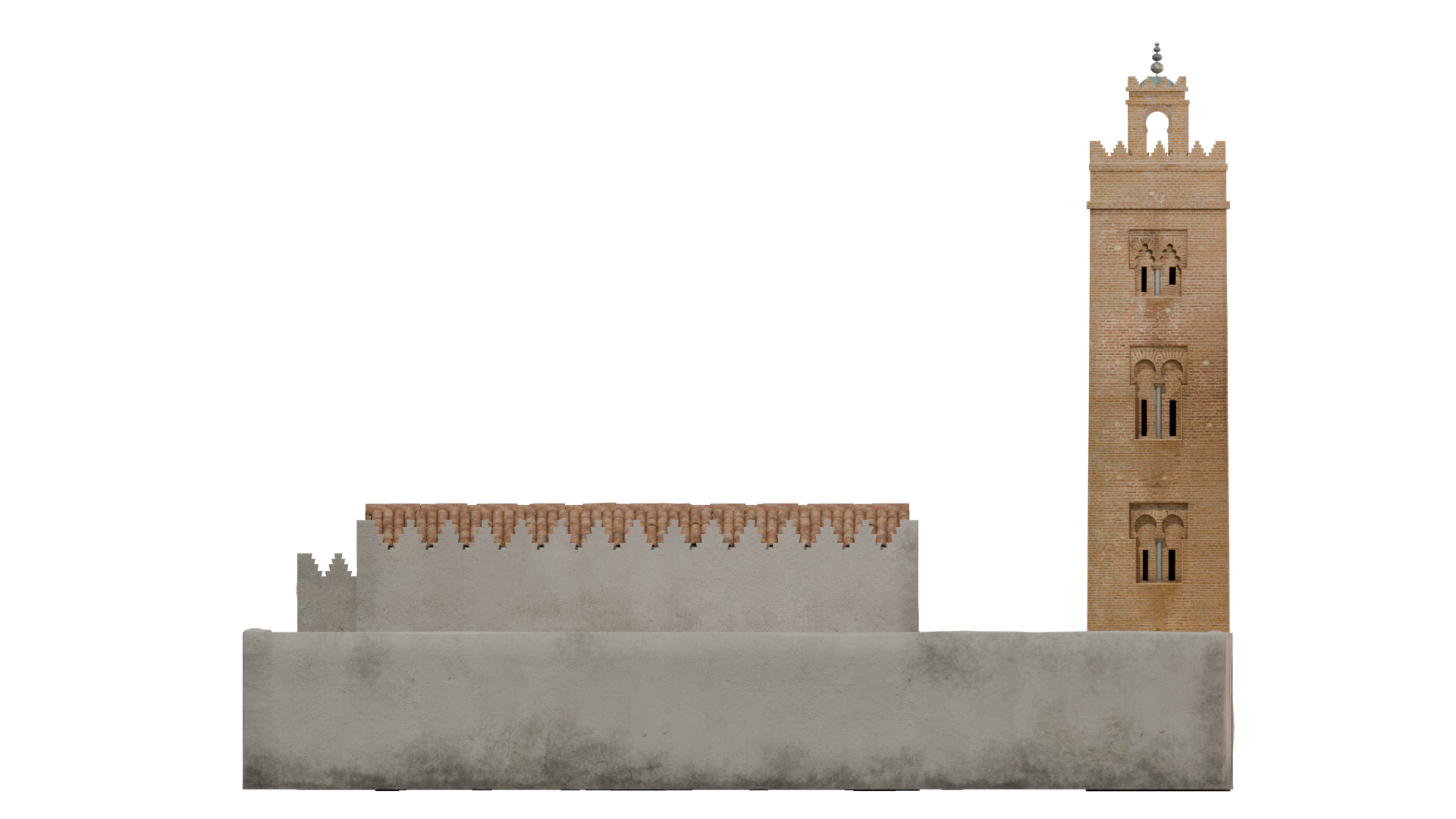
The mosque of Cuatrovitas was surrounded by a low wall or wall that closed the complex formed by the prayer room or haram, the minaret or minaret and the ablutions courtyard or sahn.
Of the complex, the minaret stands out, preserved practically intact, since only the upper body has disappeared through which the muezzin accessed the terrace to make the call to prayer. This element is characterised by the massive use of brick and the subdivision into bodies through the arrangement of windows through which the spiral staircase that ascends the interior was illuminated. On each side, double openings were placed at different heights, some of them framed in simple alfices and topped with a double horseshoe arch or a double lobed arch. These arches, in their origin, would have been supported by columns that acted as mullion and that have disappeared. Thanks to an engraving dated in the 17th-18th centuries, we know that the upper body would have been topped with a three-sphere mast or yamur, similar to the one that the Giralda had, which was probably lost as a consequence of the Lisbon earthquake in 1775.
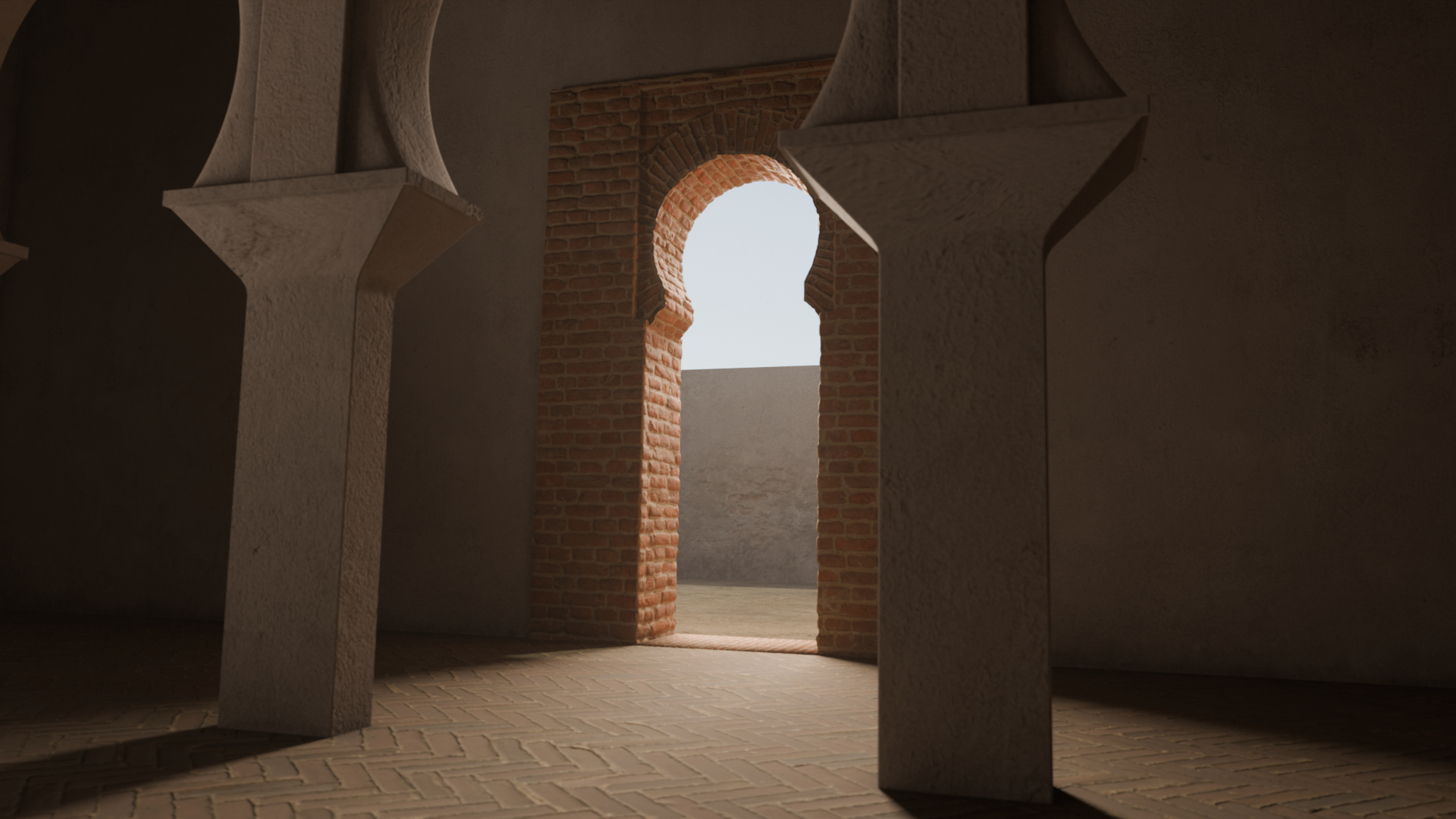
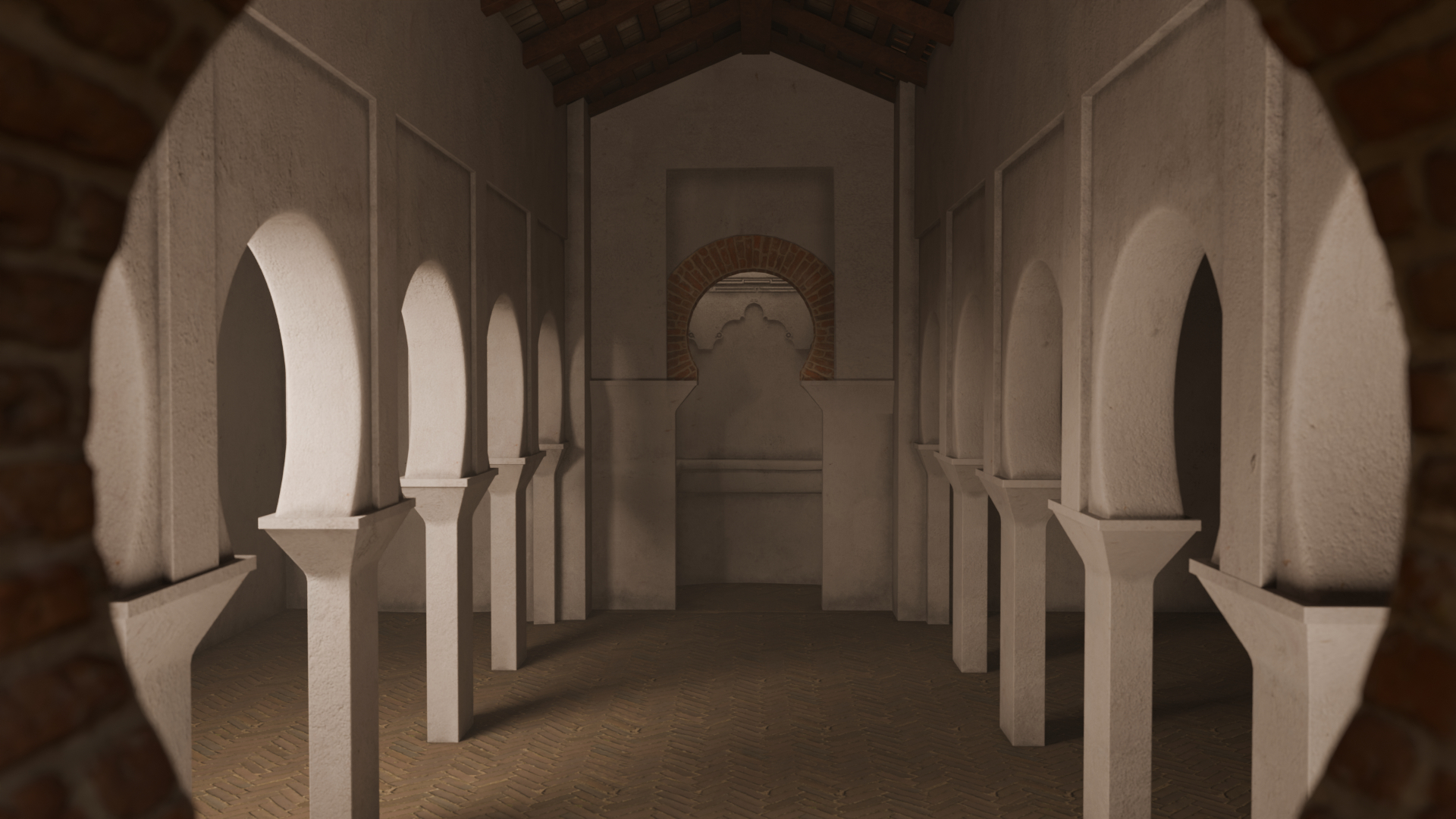
The patio is located before the prayer room. According to the Islamic rite, before praying the faithful must purify themselves by performing a washing or ablution. The presence of a water well in this open space could be proof of its use for this ritual, storing the purifying liquid in an ablution basin. Once purified, believers could enter the prayer room, the main entrance of which was to the northeast. Through a door topped by a horseshoe arch, they entered a rectangular room made up of three naves divided into the five sections that are preserved today. The central nave was separated from the side naves by horseshoe arches on square brick pillars. These arches were re-cut, but they are the ones that still support the central naves.
On the east side, an auxiliary door also allowed access to the interior of the building from the courtyard. At the back of the central nave was the mihrab, a niche located in the center of the qibla wall, which marks the canonical direction of prayer. This is the most important space in the mosque, since it is where the faithful must direct their gaze and next to it the imam is placed to lead the prayer. Although only the foundations of the mihrab have been documented, the data extracted from the excavations, as well as the information obtained from other rural mosques, have allowed a hypothetical reconstruction of its elevation and interior decoration to be carried out.
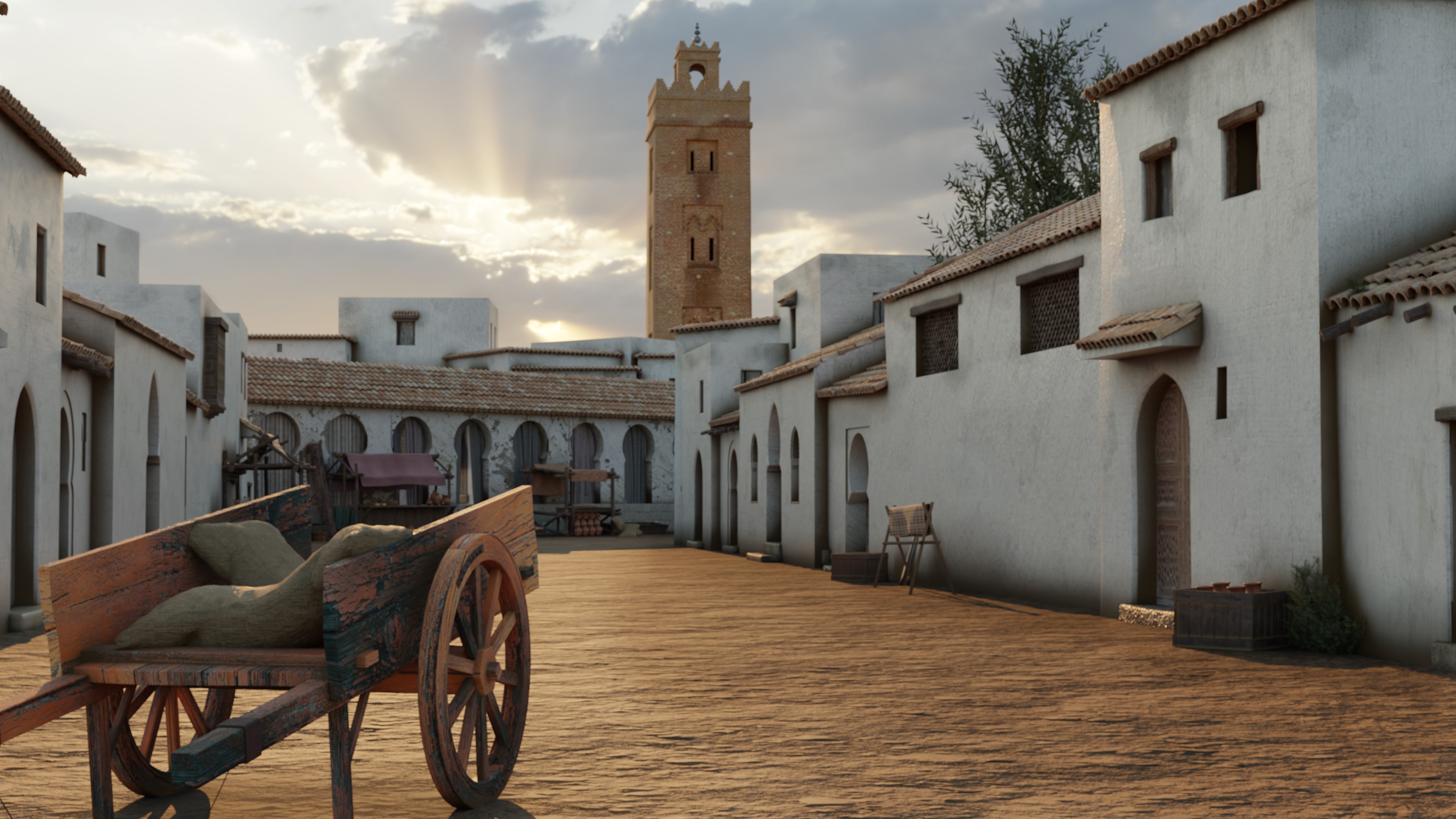
The mosque would have been maintained with few reforms in the moments after the Castilian conquest, the earliest of which was perhaps the demolition of the enclosing wall. Later, and already in the transition between the Middle Ages and the Renaissance, two naves were added to the sides and, later, another one to the qibla wall. Despite the reforms carried out, the naves and the Almohad minaret of the original building are preserved; the gradual abandonment of the town, of which the Cuatrovitas estate remains as the only testimony today, is not unrelated to the preservation of this complex. However, geophysical surveys and the excavation of some houses allow us to get closer to the urban layout and the morphology of the buildings of the Almohad period.
The village served by the mosque was located on the left bank of the Norieta stream. The landscape showed a gentle relief dominated by areas of orchards, vineyards and pastures around the town centre and wheat fields, olive groves and scrubland in more distant areas. The buildings were arranged in streets that form square blocks, giving rise to a fairly regular checkerboard grid with a slightly less ordered area around the mosque. Perhaps the reason is that the buildings grouped around the mosque were the oldest and, the furthest away, the result of a planned expansion of the village.
The houses documented in the archaeological excavations seem to respond to the same typology: simple rectangular or quadrangular constructions with a large interior garden courtyard, where the well is located, and open rooms around the courtyard. Following the dominant pattern in the Islamic world, the houses are conceived as a space closed to the outside where the openings to the street are the minimum necessary, offering privacy to the inhabitants, in contrast to the interior space articulated around the courtyard onto which the different rooms open.
3D Objects
Videos
Cuatrovitas: Hermitage and town
Bibliography
GUARRIARÁN DAZA, P. Acerca del alminar almohade de Cuatrovitas en Bollullos de la Mitación (Sevilla). Caetaria. 3. 2000.
HEINDEREICH, A. Cuatrovitas (Bollullos de la Mitación. Sevilla). Nuevas investigaciones sobre el asentamiento abandonado y la mezquita almohade. 2017.