
- Home
- Interest points
- Castle of La Puebla de los Infantes
Info
Castle located at about 231 m above sea level on a platform surrounded by two ravines. It is located in a contact zone between the Sierra and the Campiña, between Sierra Morena and the Guadalquivir valley. In its surroundings there are important fortifications such as Almenara, Toledillo, Peñaflor, Palma del Río, Lora del Río. However, this fortress was linked to Constantina, as the head town of Sierra Morena in this territory that we now call the Sierra Norte of Seville.
Know more
History
In the demarcation of the boundary of Seville carried out in 1253, the place name Castriel appears. This place was within the district of Cannebollo, a village to which Alfonso X gave the name of Puebla del Ynfante, which was donated to don Enrique Enríquez, son of the infante don Enrique and, therefore, nephew of the king.
The castle of Puebla de los Infantes is not mentioned as such until 1344, the year in which Alfonso XI granted a new Ordinance to the city of Seville; from this document it can be deduced that the castle of Puebla de los Infantes belonged to the Sevillian council, together with others in this province such as: Lebrija, Alcalá de Guadaira, el Bollo (tower), el Aguila (tower), Alcantarilla (tower), Alocaz, Utrera, Las Cabezas de San Juan and Constantina. These same names appear cited in the Ordinances of Seville promulgated in the time of the Catholic Monarchs and published in 1527.
Taking into account the sources mentioned above, the construction of the castle must have taken place between 1335 and 1344, years in which the interest in defending and repopulating the land of Seville had its immediate consequences in the construction of castles and towers by the aristocracy, the military orders, the ecclesiastical chapter of Seville and the city council itself; all of them impelled by the monarchy with the aim of settling the population for the consolidation of the kingdom of Seville, or in other words, of the frontier with the kingdom of Granada. This particular fortification was built ex novo by the Christians.
In the Municipal Archive of Seville, the names of the governors of the fortress between 1410 and 1499 are preserved, up to 12 of them, all of them veinticuatro knights of the Sevillian council (equivalent to a kind of councillors of the period); several works financed from Seville in the years 1399, 1405, 1494 and 1499 are also recorded.
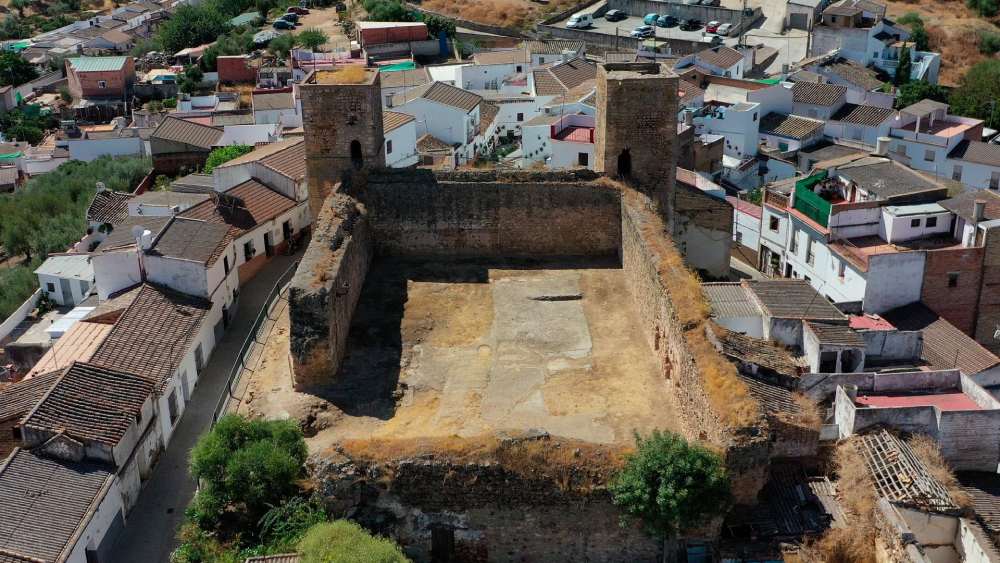
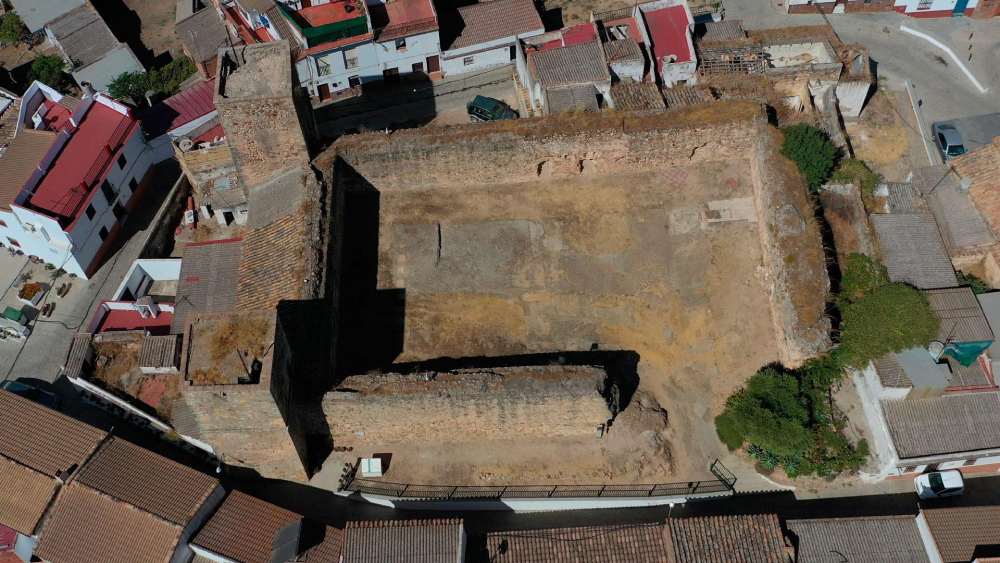
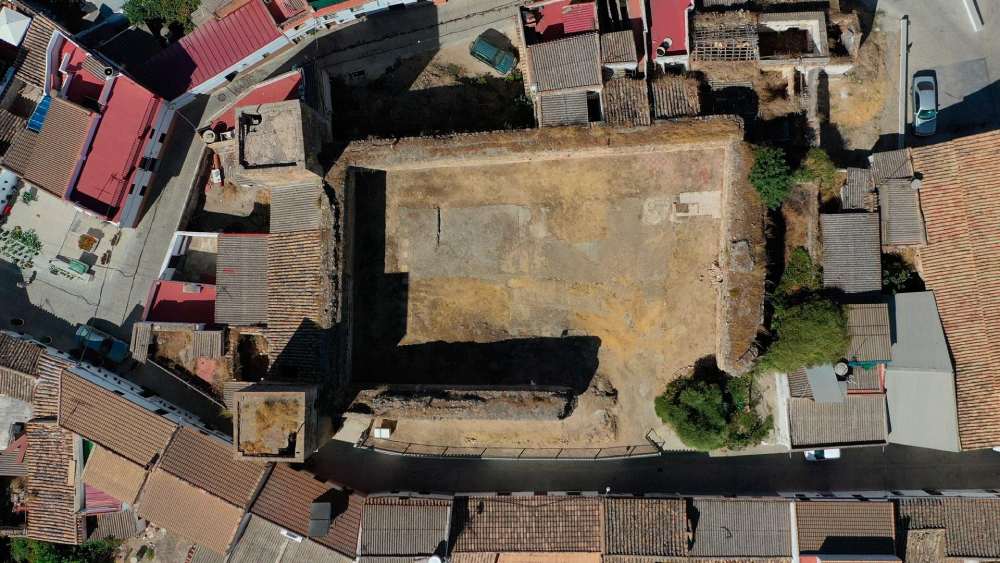
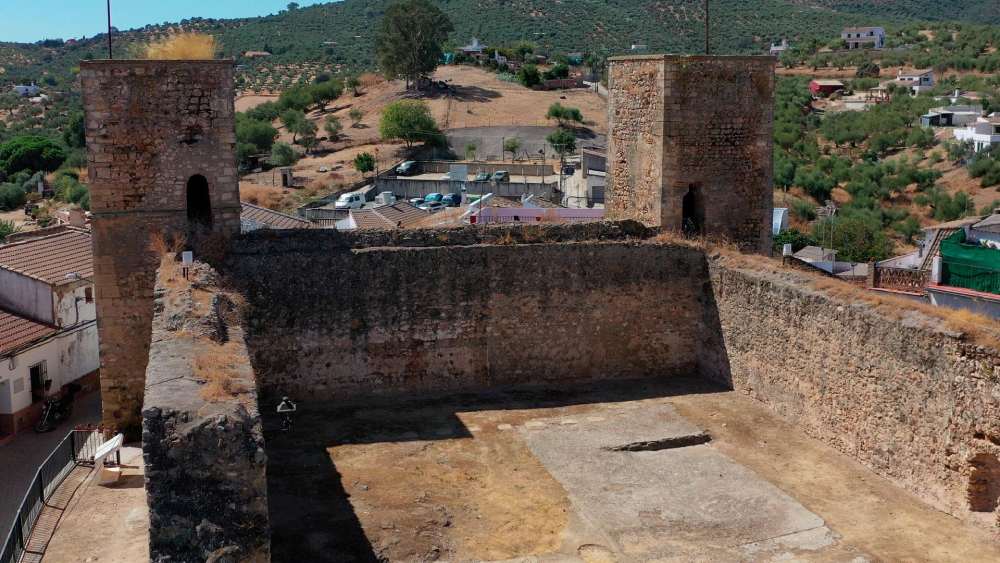
The castle of Puebla de los Infantes is almost rectangular in plan, erected on an eminence with pronounced slopes. Its architectural structure was made up of four curtain walls and four towers; of these, the two southern towers and three curtain walls still survive in elevation today. Its state of conservation is one of progressive ruin, and no consolidation appropriate to the entity of the monument has so far been undertaken, although at least the houses that were parasitic upon the monument have been removed.
Its exterior perimeter is 40 x 25 m, the courtyard measures 28.5 x 17 m and the thickness of its walls is uneven: the northern curtain wall is 3 m wide, the southern side 1.65 m, the eastern side 2.1 m and the western side 1.9 m, with an exterior height of about 6.6 m.
The construction material is masonry, made with stone extracted from the hill itself and limestone from the surroundings. In its walls and towers we can observe up to three different types of masonry arrangement, which must be the consequence of successive works over time, which are:
- Western, southern and eastern curtain walls. Typologically they are identical; it is masonry of very variable sizes, ranging from medium to small, organised in courses and with a very hard ochre-coloured mortar.
- Northern curtain wall. It is the same stone, but its arrangement is very disorderly. This same type of masonry arrangement is detected in the raising of the wall-walk on the southern and eastern curtain walls of the enclosure.
- The towers, with a mixed masonry arrangement based on limestone ashlars in the corners and wall faces of medium and small rubble stones organised in courses, combined with brick bands (generally red, measuring 27 x 13.5 x 4.5 cm).
- To the masonry, other construction materials must be added, which are:
- Brick, used to frame the openings and in the vault of the castle gate.
- Concrete, detected in the eastern stretch of the wall, forming the parapet.
- Limestone ashlars, which are preserved in the corners of the towers and which surely must also have framed the entrance openings to the towers and the castle gate. No ashlars remain, as they were replaced by solid bricks with cement in the 1980s. The sail vaults that cover the chambers of the towers are also made of limestone ashlars.
What seems to have been the only gate of the enclosure is located in the northern stretch. It is a narrow access, 1.44 m wide, which has lost the outer and inner arches and which, as its only evidence, preserves the inner vault, which is made of brick and has the form of a pointed barrel vault.
The towers are practically square; they have the same masonry arrangement and are solid up to the height of the wall-walk or patrol path, reaching 12 m in height. Several differences can be observed between them:
- The southeast tower measures 4.86 x 4.65 m on the exterior and is therefore almost square. Solid up to the height of the wall-walk, it preserves, at the height of the floor of the chamber, a stone belt course that runs around its perimeter. This room (type 2 masonry arrangement) is covered with a pointed sail vault that rests on pendentives. The joints on the exterior of the tower are rendered with a white strip that preserves vertical and horizontal incisions marking the outline of the stones. The interior walls are rendered with cement, but they seem to correspond to type 2 masonry arrangement. The access staircase to the roof terrace is embedded in the eastern wall and does not preserve the covering.
- The southwest tower measures 5.2 x 5.2 m, is also almost square, and has two superimposed chambers. The lower chamber, at the height of the wall-walk, partially preserves its original access in the form of a segmental arch and one of the pivot sockets of the door—which must have been double-leafed; the vault, completely destroyed, only preserves the rubble fill; this chamber has three arrow slits, one on each external side. The upper chamber is identical to the one we have described in the southeast tower. The staircase to the terrace is embedded in the western stretch and is very much lost.
This building has at least two construction stages, which are:
- The foundational stage, which corresponds to most of the building. These are the western, southern and eastern curtain walls of the wall; plus the chambers of the towers up to the height of the stone belt course of the southeast tower, and the lower chamber of the southwest tower.
- A second stage in which the northern wall was rebuilt, the southern and eastern wall-walks were raised in height and the chambers of the towers with the roofing based on limestone ashlars were incorporated. To this second phase must correspond the barrier or barbican, separated 4 m from the northern wall, which flanks (defends) the gate that preserves a brick opening of 1.44 x 2.3 m and the brick vault, also a pointed barrel vault. Next to the gate, traces of the staircase attached to the wall are preserved.
Without doubt, the construction of the castle must have taken place between 1335 and 1344; the foundational stage corresponds to these dates. The second stage, from the typological point of view (the only vaults of this type in the province of Seville are found in the castle of Alcalá de Guadaira and are dated to the 15th century), and according to the records of works in the Municipal Archive of Seville, places us at the end of the 15th century.
Within the group of castles of the Sierra Norte, La Puebla de los Infantes is one of the best-preserved castles. It responds to the programme of Alfonso XI to secure and settle the population, of which we have so many examples in the districts of La Vega and La Campiña.
3D Objects
Videos
La Puebla de los Infantes Castle
Bibliography
Toribio García, Juan José (2015) “El castillo de Puebla de los Infantes (Sevilla). Estudio histórico-artístico”. Arte, Arqueología, Historia. Córdoba: 15, 307-315.
Valor Piechotta, Magdalena (2009) “La arquitectura defensiva en el Parque Natural de la Sierra Norte de Sevilla: los castillos en núcleos urbanos” en Filter Rodríguez, J.A. (ed) Actas VI Jornadas de Historia sobre la Provincia de Sevilla. Sierra Norte. Sevilla: 55-75.