
- Home
- Interest points
- Castle of El Real de la Jara
Info
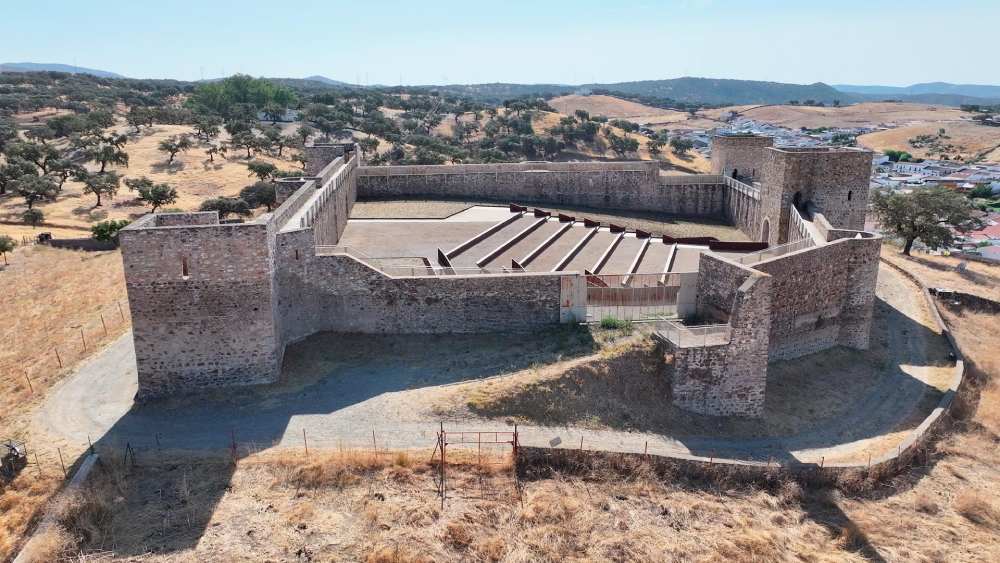
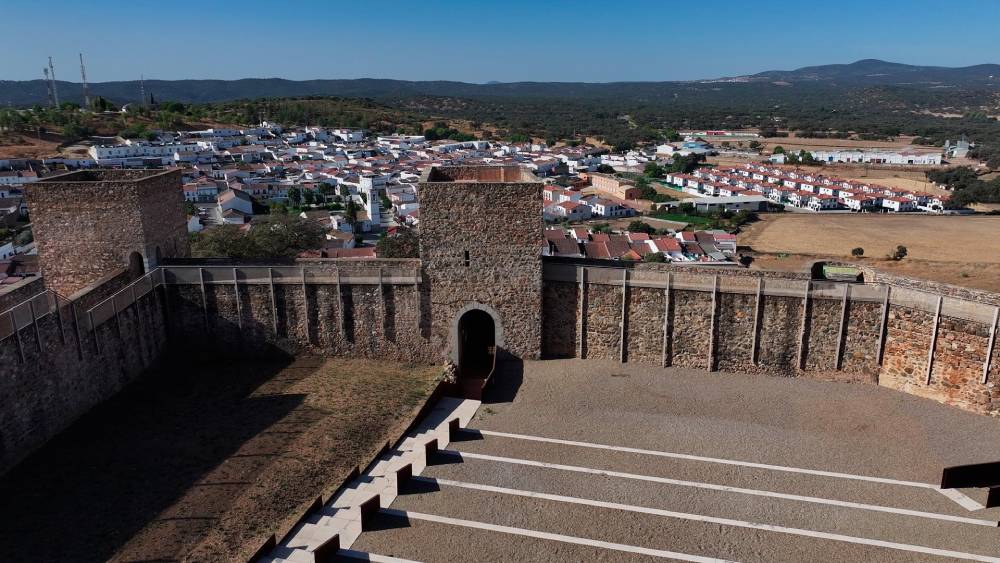
The Castle of Real de la Jara, built in the 14th century, is strategically located on a hill to control the Vía de la Plata and defend the Seville district against Portugal. Its semi-drangular masonry enclosure has eight towers, two gates (a main gate in the keep and an escape gate) and a parade ground with a cistern.
Know more
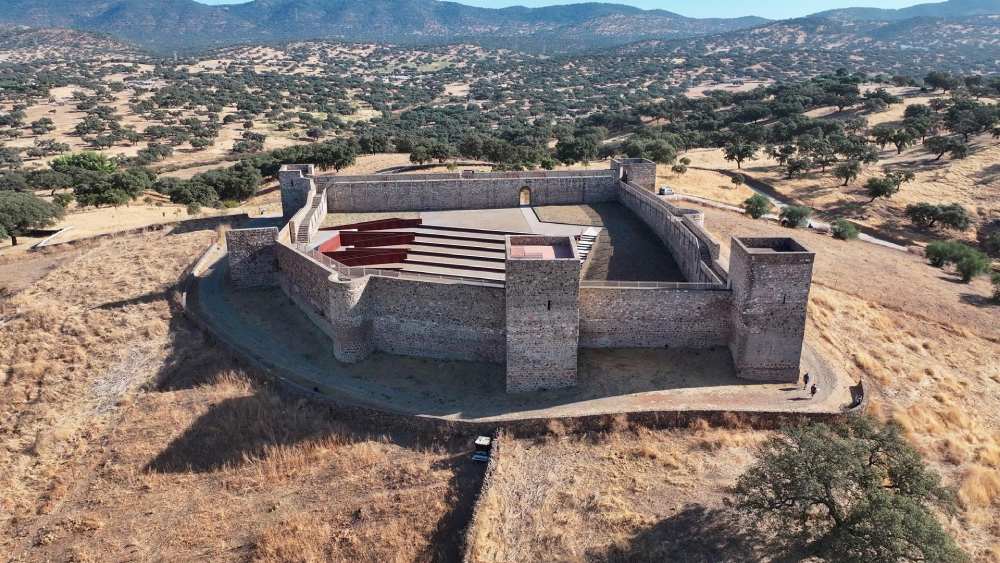
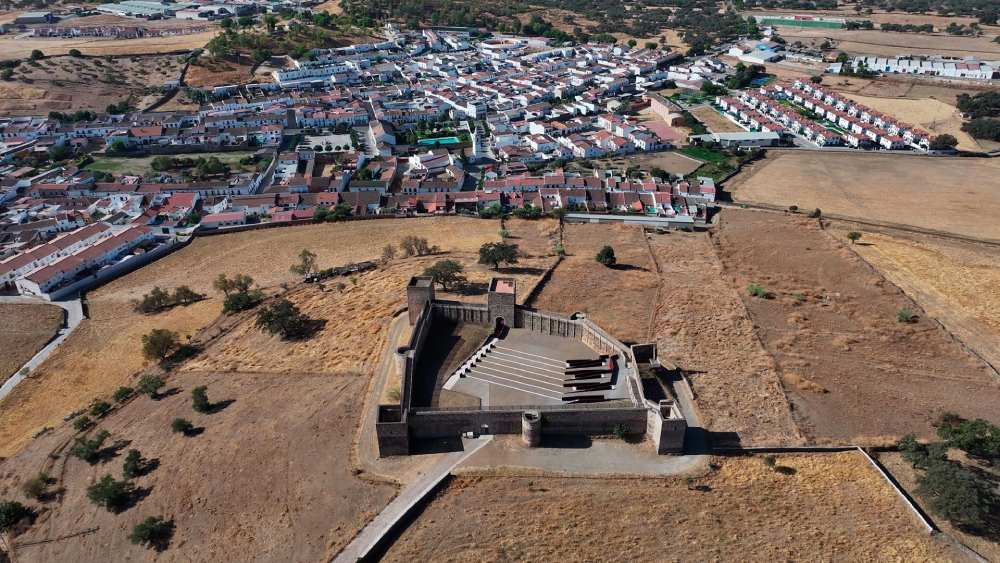
The castle of El Real de la Jara is strategically located at the confluence of the current provinces of Seville, Huelva and Badajoz, on a high hill at an altitude of 535 metres above sea level, from which it controls one of the main communication arteries of the region: the Vía de la Plata (Silver Route).
Its location also allowed it to maintain a visual relationship with the castles of Cala, Santa Olalla de Cala and Las Torres, making it an essential enclave for the defence and control of the territory during the Late Middle Ages.
The construction dates back to the 14th century and is linked to the defence of the alfoz of Seville against the neighbouring kingdom of Portugal and the orders of Santiago and the Temple, forming part of the group of fortresses belonging to the so-called ‘Banda Gallega’.
The proximity to the Portuguese border and the conflicts that arose during these times with the neighbouring kingdom and the aforementioned military orders, as well as the need to control the important Silver Route, led the council of Seville to request authorisation from King Sancho IV in 1293 to build a series of castles in order to reinforce the borders of its district.
For more than a century the fortress maintained its military and strategic importance, but by the 16th century and with the territory stabilised, it was losing its defensive function. This fact, together with the lack of maintenance of its buildings by the Council of Seville, led to a progressive process of deterioration and ruin.
In the mid-17th century, the castle was sold by the Crown and passed into private hands until 1836, when it was acquired by the Town Council of El Real de La Jara.
Having lost its military function, it was used as a quarry by the villagers and was subject to widespread dismantling until almost the end of the 20th century. It was at this point that the recovery of the monument began. In 1989, the first archaeological research was carried out on both the walled enclosure and the existing constructions inside the castle.
In 2005, restoration work began and a new archaeological investigation was carried out. After its restoration, by means of which the lost parts of the walls and towers were reconstructed, a stage and grandstand for shows was erected in 2008, occupying the entire parade ground.
Nowadays, access to the enclosure is via a path called ‘Camino del Castillo’ which leads from the north of the village to the castle walls.
The fortification sits directly on the natural rocky substratum, adapting to the topography of the terrain and therefore has an irregular ground plan, with a polyhedral layout covering an approximate surface area of 2,090.00 m².
The castle was built using 2.20 m thick masonry walls and eight towers: five square and three semicircular.
One of these towers is the keep, located on the southwest wall, which is larger than the others and has a large upper chamber covered by a barrel vault, with a staircase leading to the roof.
Access to the interior of the enclosure was through two doors. The main gate was located to the south, facing the town, and was built in the lower part of the keep with an angled floor plan to ensure greater protection of the fortress. The second gate was located to the north, on the opposite side, and provided direct access to the countryside.
Once inside the fortress, we find a large parade ground of almost 2,000 m2, on the west side of which was the staircase leading up to the patrol path, from which the surrounding territory was controlled.
In the square, different rooms were organised, such as dwellings, stables, storerooms and a cistern for the water supply which, during the life of the fortress, served the inhabitants of the castle.
3D Objects
Videos
Castle of Real de la Jara
Real de la Jara Castle Subtitled
Real de la Jara Castle
Bibliography
TAYLOR, R. Intervención arqueológica puntual de apoyo a la restauración en el Castillo de El Real de la Jara (Sevilla): el sector oeste del recinto. Anuario Arqueológico de Andalucía. 2005.
VARGAS DURÁN, M.A. Intervención en el Castillo de El Real de la Jara (Sevilla). Anuario Arqueológico de Andalucía. 1989.