
- Home
- Interest points
- Church of Nuestra Señora de Gracia
Info
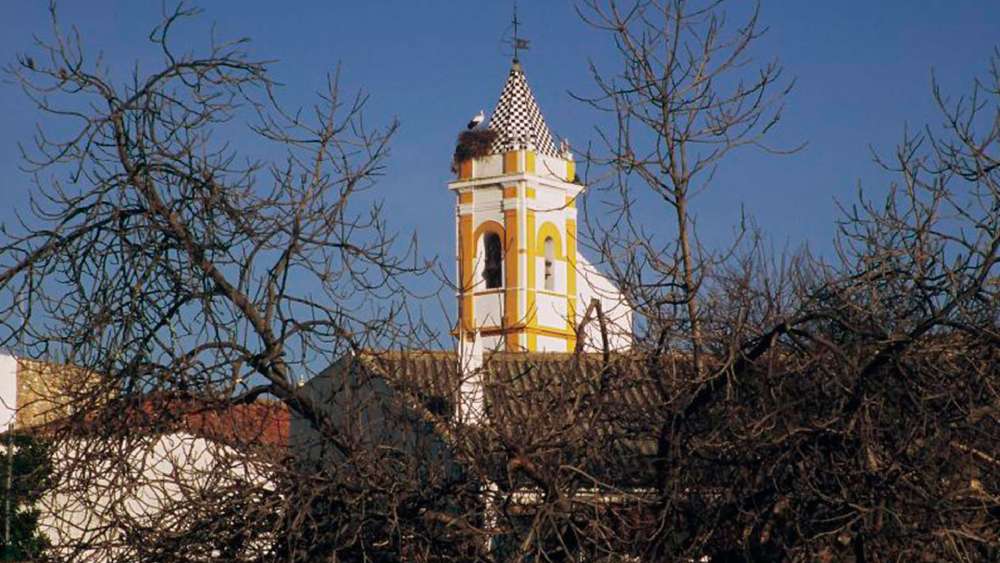
The parish church of Santa María de Gracia is located in the heart of the historic center of Almadén de la Plata, very close to what was once the medieval castle and is now the seat of the Town Hall. In front of its main façade, a wide square opens up, allowing for a full view of the church, with its slender tower standing out.
Know more
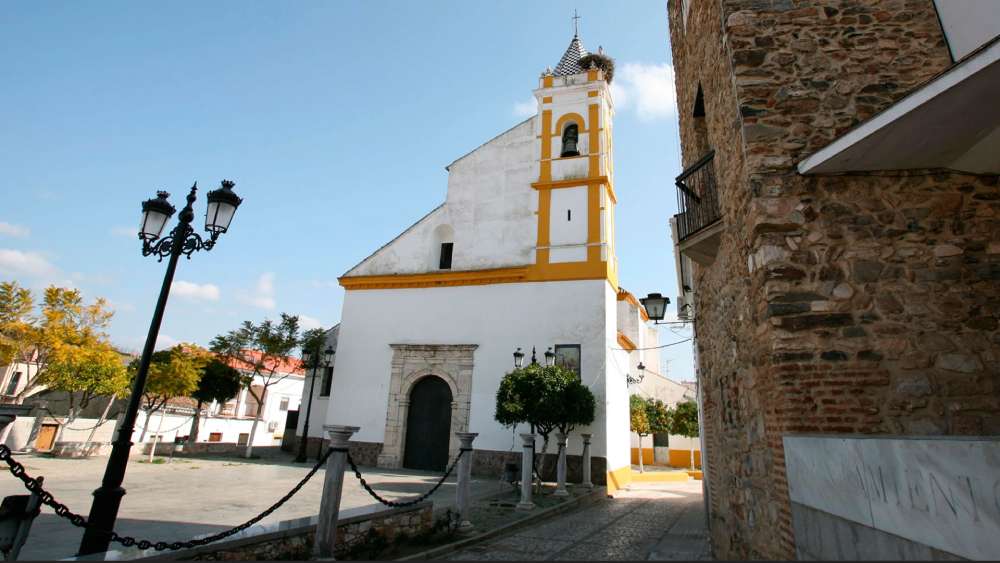
In the heart of the historic centre of Almadén de la Plata is the parish church of Santa María de Gracia, very close to what was once the medieval castle, which is currently the seat of the Town Hall. In front of its main façade there is a large square that allows you to contemplate the whole temple.
The origin of its construction dates back to the end of the 16th century and beginning of the 17th century, identifying itself with the Renaissance and Baroque styles. The church, as it has come down to us today, is the result of different construction phases in which highly prestigious architects such as Vermondo Resta, Hernán Ruiz II, Pedro Sánchez Falconete and Esteban García were involved. In a second phase, corresponding to the 18th century, remodelling works were carried out by the architects José Tirado, José Bonilla, Francisco Muñoz and Pedro de Silva. Between 1750 and 1760, works were carried out by Francisco Jiménez Bonilla who, among other parts of the temple, seems to have intervened in the tower.
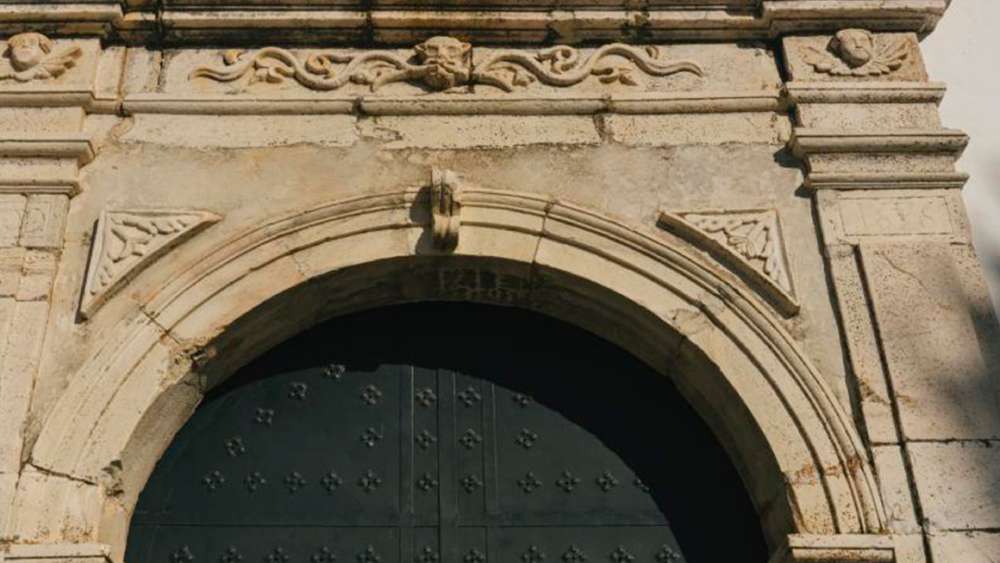
Outside, at the foot of the church, the main entrance and its slender tower stand out. The entrance, in Renaissance style, is made of marble from the local quarries. It consists of a semicircular arch between Tuscan pilasters and an entablature decorated with grotesques in the central area and cherub heads on the sides. The bell tower is made up of three bodies, delimited by projecting cornices. It has a single body of bells structured by pilasters and topped with a simple octagonal spire covered with white and cobalt blue tiles. Its construction dates back to the 17th century and is the work of the architect Esteban García, although in the following century the master Francisco Jiménez Bonilla intervened on it.
The temple consists of a single nave divided into four sections with side chapels and a high choir at the foot. The nave is covered by a barrel vault with transverse arches and lunettes. In the background, behind the triumphal arch, is the main chapel, with a square floor plan and a half-orange vault on pendentives, where we can see a profuse polychrome mural decoration.
On January 4, 1953, the church of Santa María de Gracia suffered a serious fire that destroyed part of its artistic treasures, such as the main altarpiece in baroque style, which was reduced to ashes along with the sculptures it housed: the primitive image of the patron saint, Our Lady of Grace, and a valuable carving of a crucified Christ, the work of Roque Balduque, which occupied the attic of the old altarpiece and is now preserved in the sacristy.
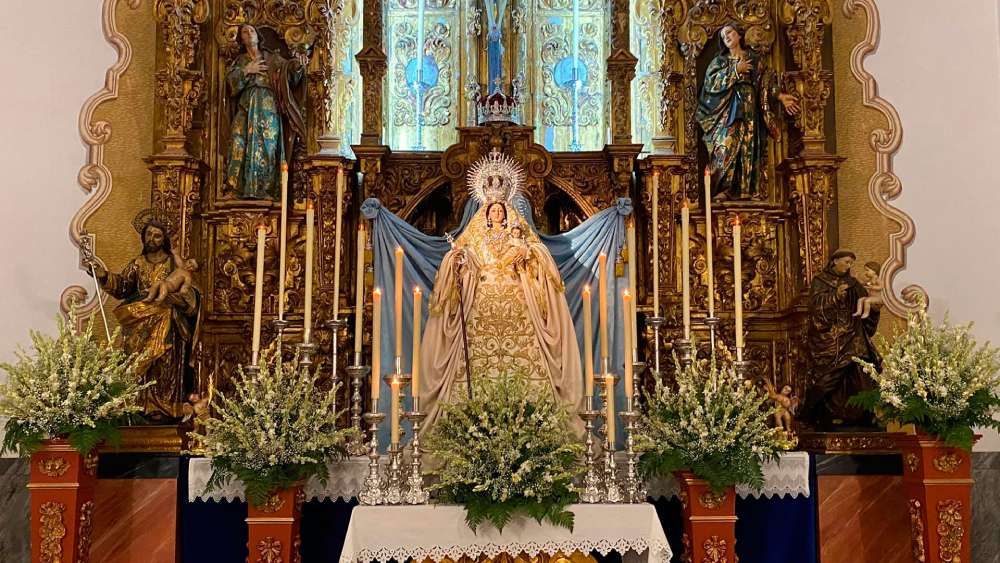
The main altarpiece that we can see today comes from the Church of San Felipe de Carmona (Seville). It is a splendid work of Sevillian baroque made of carved and gilded wood, in which its rich decoration stands out. In the centre, presiding over the altarpiece, is the Cristo del Crucero, an anonymous sculpture from the beginning of the 16th century, the patron saint of Almadén de la Plata and an image of great veneration. The sculptural ensemble contains valuable baroque sculptures from the 17th and 18th centuries:
On the side streets, on both sides of the Cristo del Crucero and on high corbels, we can see the images of Saint John the Evangelist and Mary Magdalene. In the upper part, in the attic and under a semicircular arch, is the sculpture of the Immaculate Conception. In the lower part, above the tabernacle, a niche formed by a large semicircular arch houses a sculpture of the Child Jesus, from the Seville school. On the sides of the altarpiece are the sculptures of Saint Joseph and Saint Anthony of Padua.
Another admirable element of the main chapel is the beautiful doorway that leads to the sacristy, made by the master builder Esteban García in 1676. The doorway is flanked by Solomonic columns, on which stands a split pediment whose central space is occupied by a cross on a pedestal. Next to the Main Chapel, on the Epistle wall, is the altarpiece with the Virgin of Grace, an image of glory by the local sculptor Jaime Mate, which replaced the one affected by the fire in 1953. Opposite it, on the Gospel wall, we can see a beautiful, profusely decorated 18th-century Baroque altarpiece, also from the Church of San Felipe de Carmona, which houses an image of the Divine Shepherdess of Souls, a work by the sculptor and religious image maker Francisco Buiza, dated 1955.
Also located on the Gospel wall are the Chapel of the Virgin of Sorrows and the Chapel of Jesus of Nazareth. The first shows an exuberant decoration made with mural painting. It venerates the Virgin of Sorrows, a Baroque carving by an unknown artist, and the Recumbent Christ, a round sculpture from the 18th century that must have originally belonged to a descendant. In the chapel of Jesus of Nazareth we find this image of great devotion of Christ carrying the cross, a baroque carving from the Andalusian school.
Bibliography
ANGULO ÍÑIGUEZ, D. Arquitectura mudéjar sevillana de los siglos XIII, XIV y XV. Boletín de la Sociedad Española de Excursiones. 1932.
CRUZ ISIDORO, F. Pedro Sánchez Falconete (ca. 1586/1587-1666).
FERNÁNDEZ CACHO, Y. Una personalidad inédita de la arquitectura sevillana del setecientos: Francisco Jiménez Bonilla.
HERNÁNDEZ NÚÑEZ, J. C. Algunas reflexiones sobre las ermitas de la provincia de Sevilla y sus bienes muebles.
HERNÁNDEZ GONZÁLEZ, S. Las ermitas de Alanís. Revista de Alanís. 1997.
PÉREZ, A. Ermitas, monasterios y conventos de Alanís. Difundiendo Alanís. 2018.
VALDIVIESO, E. Guía artística de Sevilla y su provincia.
VVAA. Iglesia de Nuestra Señora de Gracia. Ficha Técnica Junta de Andalucía.
VVAA. El gótico-mudéjar por la provincia de Sevilla. 2015.