
- Home
- Interest points
- Castle of Alanís
Info
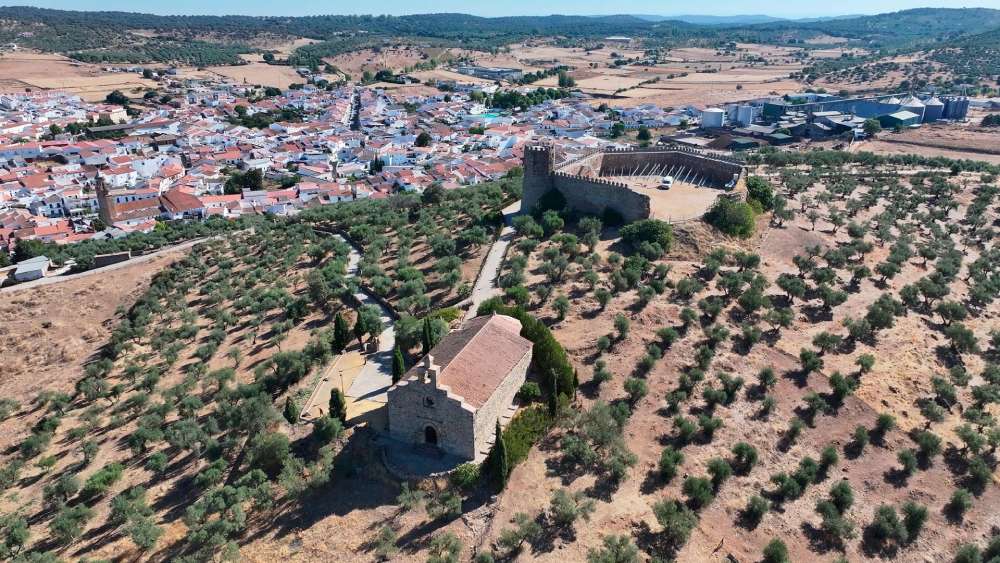
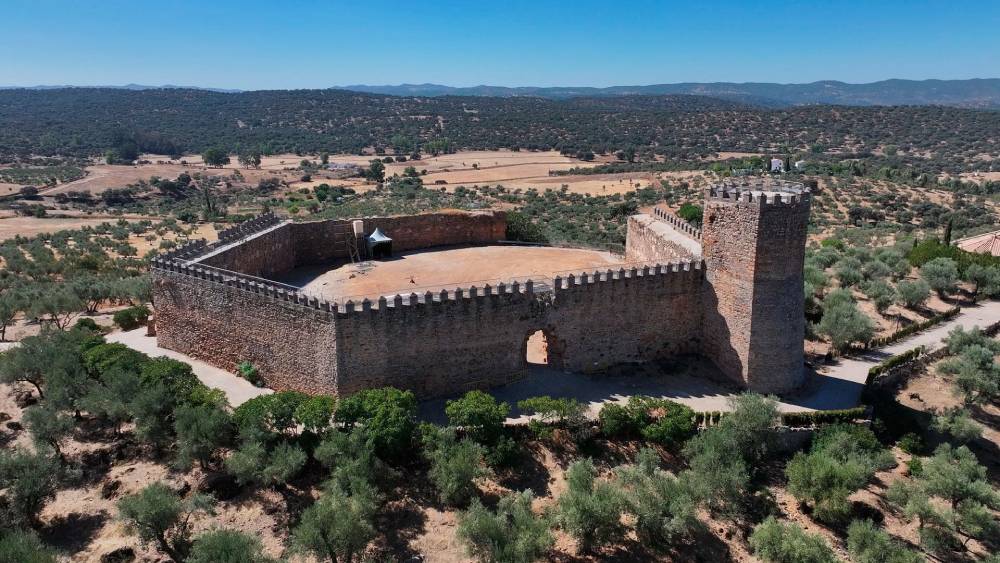
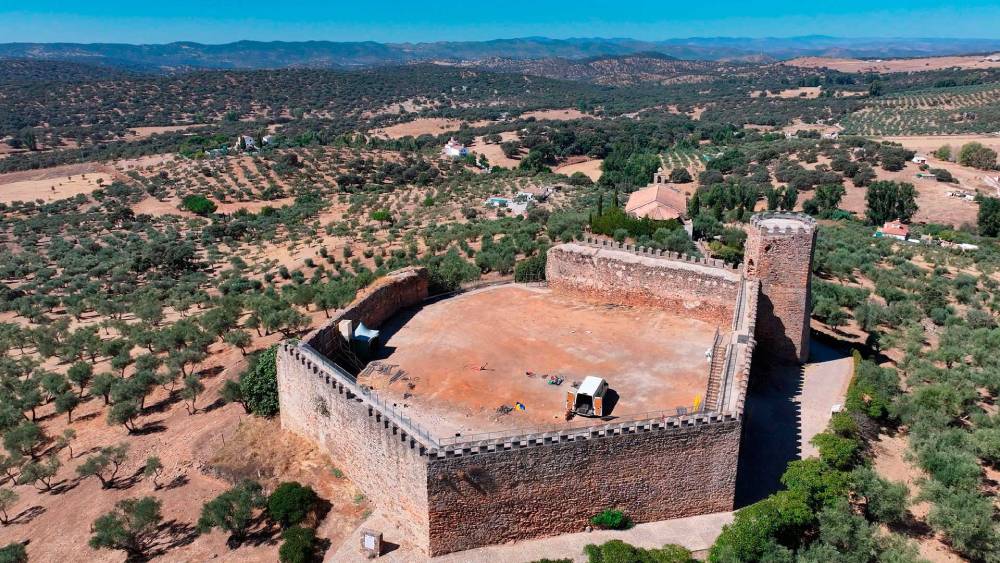
A castle on the defensive line, which protected the northern border of the Kingdom of Seville. It consists of an irregular hexagonal enclosure with a tower and a barbican. It was built in the late 14th century – the period to which most of the building dates – but the tower chamber and the double-flight staircase were added during the second half of the 15th century.
Know more
Alanís Castle was built in the late 14th century, between 1386 and 1392, according to the Papeles de Mayordomazgo del Concejo de Sevilla (a collection of documents detailing the financial management of the stewards between the 14th and 16th centuries).
In the mid-15th century, the jurados (representatives of the townspeople) of Seville complained that some of the Council’s castles, whose purpose was to protect those living in the surrounding areas, had become fortresses used against the local people, as their occupants robbed them and took refuge within their walls; this was the case in Aracena, Alanís, Constantina and Alcalá de Guadaira.
During the wars between the noble factions of the Guzmans (House of Medina Sidonia) and the Ponce de Leóns (House of Arcos) between 1469 and 1473, this fortified enclave was of interest to both sides as a means of controlling access to Seville from the north.
Alanís Castle is a strategic stronghold, guarding one of the entrances between the Meseta and the Guadalquivir Valley. It is situated at 720 m above sea level and has an irregular hexagonal layout, with curtain walls ranging from 38.20 m (the longest) to 1.65 m (the shortest).
The walls are 2.10 m wide, with an external height of between 7.70 and 8.80 m and an internal height of between 6.00 and 7.50 m. The parapet walk varies in width from 1.40 to 2 m. As for the coping, the original 60 cm-wide parapet remains in some places. What remained of the original battlements was destroyed when, not so long ago, irregular cement and brick merlons were added.
The main gate, situated in the centre of the northern curtain wall, has been preserved. It is a direct access gate, which was flanked by the barrier or barbican, thus forming a bend. The outer arch has not survived; at the top, there are traces of a loopholes, evidenced by: the opening in the coping and the four corbels with double chamfering; this is a vertical firing mechanism very common in fortifications in the Kingdom of Seville from the second half of the 14th century onwards.
The entrance arch may have been made of stone voussoirs, some of which have been found on the castle hill, next to the chapel. As for the doorway, the two keyholes are the most prominent features, suggesting it was a double-leaf door with a door hinge, as well as a square mortise measuring 25 x 30 cm into which the ‘alamud’ (a wooden beam used as a bolt) fitted; the vault between the two arches (inner and outer) is a barrel vault.
During the second construction phase mentioned above, a double-flight staircase was added to the gate, attached to the north curtain wall and situated above the doorway; it was therefore necessary to construct a new façade, which is the only one that survives and consists of a red-brick portal with a pointed arch and an alfiz, topped by a cornice of chamfered bricks between two courses of stretcher-bond brickwork, all in the Mudejar style.
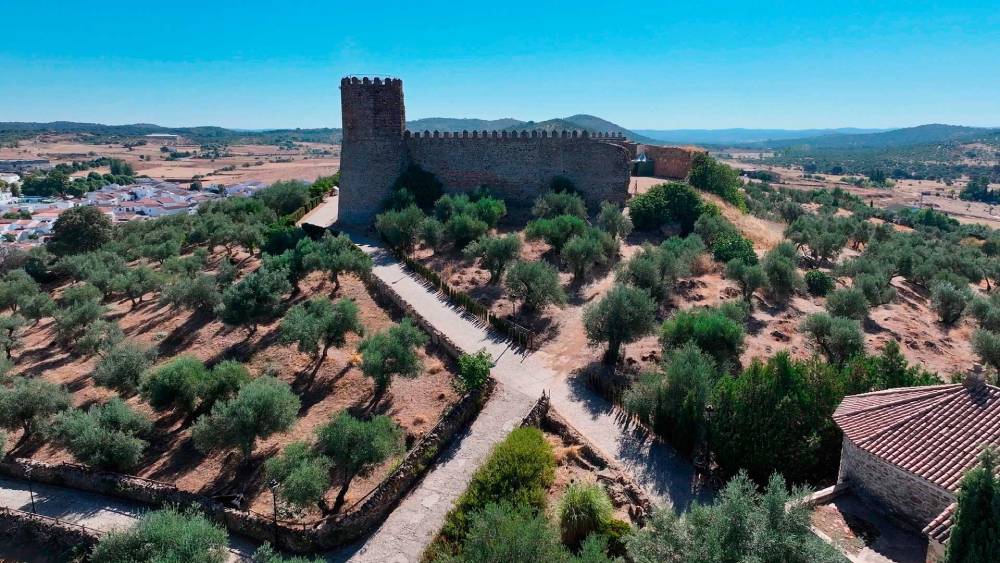
The castle has a single tower in which two phases of construction can be seen. The original section is a cube (solid structure) up to the level of the parapet walk; this was undoubtedly reinforced with a buttress (external slope) up to the level of the parapet walk; built on top of this is a nine-sided (nonagonal) chamber with the aforementioned mixed masonry (corrugated stone and brick), covered by a barrel vault resting on four corbels; on the east side, a staircase set into the wall leads up to the roof. The keep is 16.50 m high on the outside and 6.80 m high on the inside. The original crowning element has been lost, but holes for corbels remain, suggesting the presence of a machicolation that crowned the upper level of the tower (roof).
The building is well preserved, although it has suffered some losses, such as the outer arch of the gate and sections of the curtain walls, particularly the south-west and part of the north-west sections. On the south-east and north-west façades, there is evidence of a barbican or outer wall built of facing masonry of the same type as the curtain walls. The wall stands between 2.15 and 1.80 metres away from the curtain walls.
Most of the building – the curtain walls and the tower up to the level of the parapet walk – is constructed of rough-hewn masonry, with thick layers of mortar required to set the courses of stone. Brick was also used as a building material; it appears in the inner arch of the doorway, where it is a deep red colour, and in the vault of the tower. On the staircase attached to the north flank, there are also rows of red bricks set amongst the rough-hewn masonry, thus forming a mixed bond (arrangement and type of building materials).
The interior of the castle was excavated in 1987 and 1989 (three campaigns), during which it was discovered that five of its six curtain walls had adjoining corridors, with the exception of the side where the gate and staircase are located; it was also found that the parade ground still partially retains its cobblestones. The corridors are between 3.50 and 4.20 m wide, and some of them are up to 11 m long. The roof was a single-pitched roof with flat tiles.
The pottery found during the archaeological excavation shows a traditional Al-Andalusian style, but adapted to the forms and decorations of Christian taste. This evidence, together with the presence of the alfiz on the castle’s inner gateway, indicates that Mudejars were still present in Alanís as late as the end of the 15th century.
The building as a whole shows evidence of two construction phases, apart from the occasional repairs that are to be expected. The first phase corresponds to the hexagonal enclosure and the tower up to the level of the parapet walk, dating from the late 14th century; the second phase, during the War of the Factions in the second half of the 15th century, saw the addition of the tower’s upper chamber and the double-flight staircase.
3D Objects
Videos
Alanís Castle
Bibliography
Guía Digital I.A.P.H. https://guiadigital.iaph.es/bien/inmueble/8455/sevilla/alanis/castillo
Luis de Mora-Figueroa (1994) Glosario de Arquitectura Defensiva Medieval. Cádiz.
César Rodríguez Achútegui (1991) “Análisis histórico arqueológico del castillo de Alanís de la Sierra (Sevilla)”. Castillos de España,nº 98, 3-12.
César Rodríguez Achútegui.
http://www.alanis-aperez.es/historia/ANALISIS_HISTORICO-ARQUEOLOGICO_CASTILLO.pdf