
- Home
- Interest points
- Castle of Constantina
Info
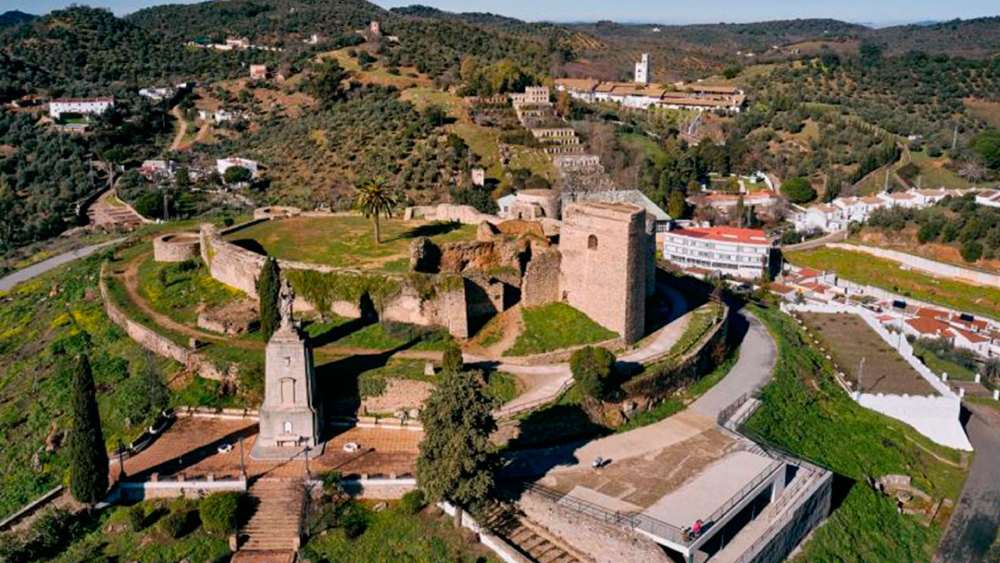
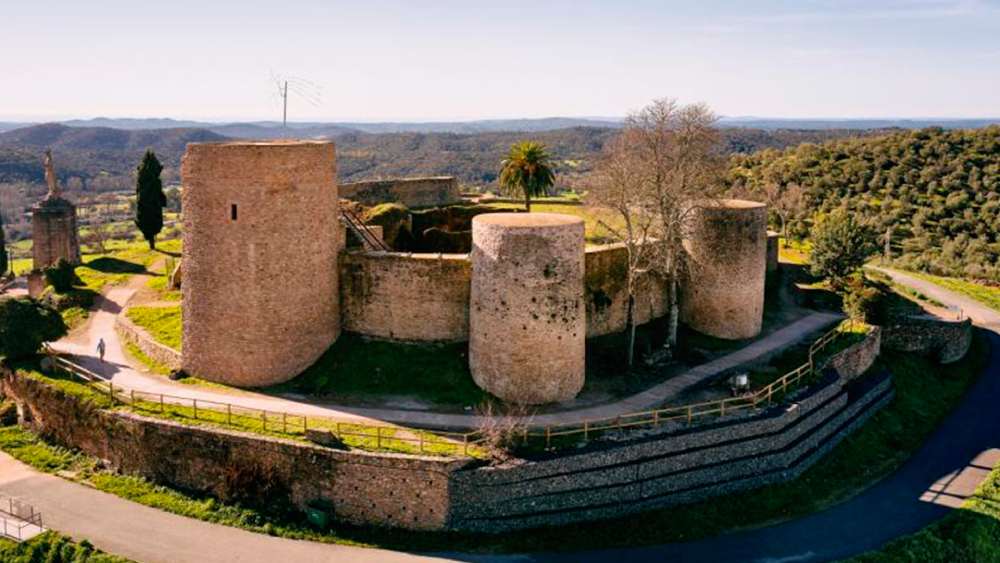
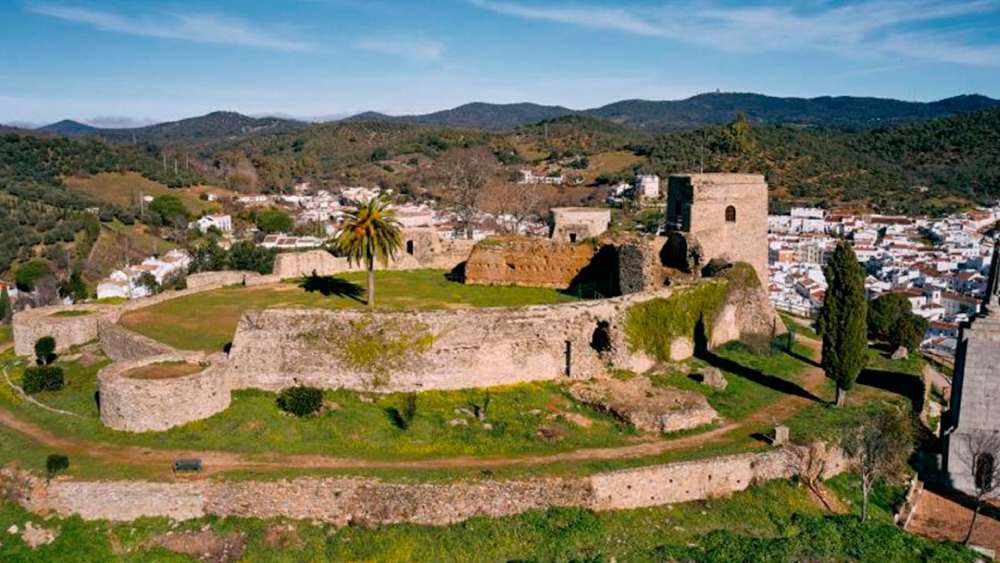
The Castle hill in Constantina was fortified for the first time in the 14th century with an oval-shaped wall to which a cistern was added. The building that we see today, oval in plan and flanked by towers of circular and ultra-semicircular plan, dates from the end of the 15th century and its builder was Rodrigo Ponce de León, at that time governor of the fortress appointed by the council (town council) of Seville. The old enclosing wall of the 14th century became the outer wall of the new castle.
Constantina was the main town of the Sierra de Constantina district, a district rich in hunting, in mines (Cerro del Hierro) and in oak, chestnut, holm oak, alder, ash and cork oak woods. Communal forests or property of the Royal Shipyards of Seville.
Know more
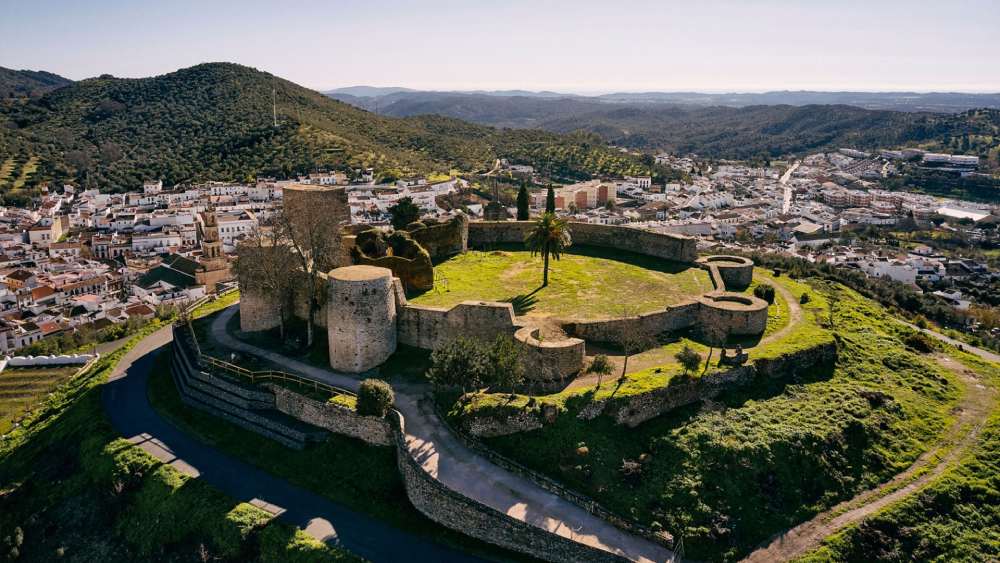
Until the year 2006 there was a sign in the castle that defined it as an “Almoravid castle”, that is, Andalusian (1090–1147); however, the archaeological activity carried out in 2006 completely changed this dating, establishing several construction phases:
The Andalusian occupation is located on a nearby hill called El Almendro; it is under Christian rule that the fortification is moved to the Castle hill, in the vicinity of the stream of La Villa and the valley of La Osa.
The Christian castle, property of the council of Seville, was built in several impulses: The first phase is from the 14th century. It consists of a large oval enclosure of 265 m in perimeter, built in rammed earth, apparently without towers, which survived in the later phase as an outer wall. Inside, in the northeast quadrant, a rectangular-plan cistern was built between 1386 and 1387, which is identical to the one in the alcazaba of the Alhambra (Granada). The cistern, with two naves supported by pillars and semicircular arches, preserves five intake mouths, two to the west and three to the south, plus three spillways to the north; inside it has four light openings and four circular holes in the vault for the collection of water.
The second phase corresponds to the castle that we see today, built between 1466 and 1474 by Rodrigo Ponce de León, at that time 10th Lord of Marchena, 3rd Count of Arcos and 2nd Marquis of Cádiz. This second phase was carried out by the governor of the castle, Rodrigo Ponce de León, who between 1471 and 1474 was immersed in the struggle between the noble factions House of Medina Sidonia (Guzmanes) and House of Arcos (Ponce de León). Immediately afterwards, between 1474 and 1478, the war of succession in the kingdom of Castile took place between Princess Isabella and Juana la Beltraneja. Rodrigo Ponce de León, governor of the fortress since 1466, also held the concession of the nearby iron mines and the control of the forests belonging to the Shipyards of Seville. The oval-plan castle adapts to the topography of the hill; it consists of five circular towers and two larger and taller ultra-semicircular towers that flank the main gate. The construction material is masonry and red brick in the vaults and the openings, doors and windows. Inside there were several buildings attached to the wall on the southeast flank and on the northwest. The use of wood was documented in the wall-walks of the northeast flank of the enclosure; the roofing between the two chambers of the circular towers, the doors and the scaffolding of the construction, with square needles, were also made of wood. Of the ultra-semicircular towers, only one has been preserved, the northeast one, called the “Torre del Homenaje”, whose ground floor was the “aula”, or representation area, covered with a barrel vault, and whose upper floor was the “camera”, or residential area of the governor or delegate of the lord.
The third phase belongs to the time of the Catholic Monarchs; the constructions must have taken place between the years 1489 and 1490, since the monarchs accompanied their daughter, Princess Isabella, on the road to Portugal when she was going to marry the heir prince of Portugal, and thus they decided to remain during the month of April 1490 in their castle of Constantina. The work consisted of demolishing a circular tower whose door, of which the deformed hollow and the threshold are preserved, gives access to a concrete platform measuring 9.30 x 7.20 m and 2.30 m in height. When proceeding with its cleaning in 2006, we detected beneath the threshold of the door ceramic materials from the end of the 15th century and, on the platform, eleven post holes. We interpret that the purpose of this structure was that of a lookout tower, from where the Monarchs could contemplate the most beautiful landscape of the surroundings, with the mills, the orchards and the hermitage of La Yedra and the Giralda of Seville itself on clear days. Another addition from this date was the wall that closes from the main gate to the cistern, making access to the interior of the fortress difficult.
In the 17th and 18th centuries there are no written records, but there are rammed-earth walls that are modern and that correspond to the upper floor of the cistern and to a second rammed-earth wall that forms a small alcázar or alcazarejo with the one already built in the Catholic Monarchs phase. Inside, numerous aligned putlog holes of the beams are preserved, and this is because it was a habitation space.
The phase of the War of Independence (1810–1812) was brief, but the French forced the men of the town to work in the castle, who came to number more than one hundred. At that time several cannon platforms were made on the truncated towers; new buildings were also fitted out, attached to the cistern on the south side and to the exterior of the alcazarejo, buildings intended to house the troops and for the storage of food and weaponry. Finally, the old brick outer wall was reinforced with masonry along the whole front facing the town, where we know that threatening cannons were installed towards the town in order to prevent a rebellion.
From the 20th century onwards, important interventions have taken place on the castle hill: the water tank of 1945, the monument to the Sacred Heart and the landscaping of the hill and castle in 1956, the access road and parking area in the 1980s, and the looting activities and clandestine excavations, which were many. In 2005–2006 there was a Workshop School consolidating walls and towers of the castle and, in 2006, the archaeological intervention that made it possible to definitively date the fortification took place. In the year 2010 a fatal event occurred, which was the collapse of the Torre del Homenaje, which could be reconstructed thanks to the photogrammetric survey, a highly precise planimetry, carried out in the 2006 campaign.
3D Objects
Videos
Constantina Castle
Bibliography
Magdalena Valor Piechotta (coord.) (2011) Historia y Arqueología de la Constatina Medieval, Sevilla: Universidad de Sevilla. Secretariado de Publicaciones
Magdalena Valor Piechotta (2011) “La Actividad Arqueológica Puntual castillo de Constantina. Conclusiones” en Valor (coord.) Historia y Arqueología de la Constatina Medieval, Sevilla: Universidad de Sevilla. Secretariado de Publicaciones: 127-143.