
- Home
- Interest points
- Monasterio San Isidoro del Campo
Info
This former convent of the Hieronymites was founded by Guzmán el Bueno in 1301 as a family pantheon over a Mozarabic hermitage where, according to tradition, the body of San Isidoro was buried.
The Chapter House is a place that has undergone numerous alterations from the 14th to the 17th century and where its pictorial decoration stands out.
Know more
MONASTERY
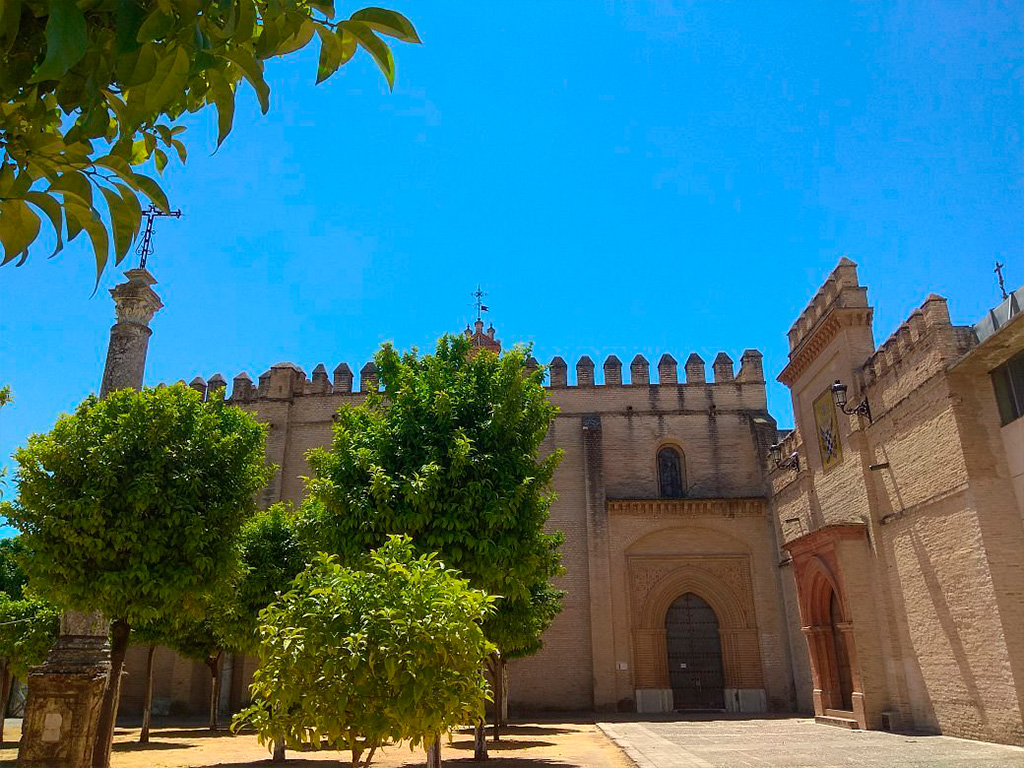
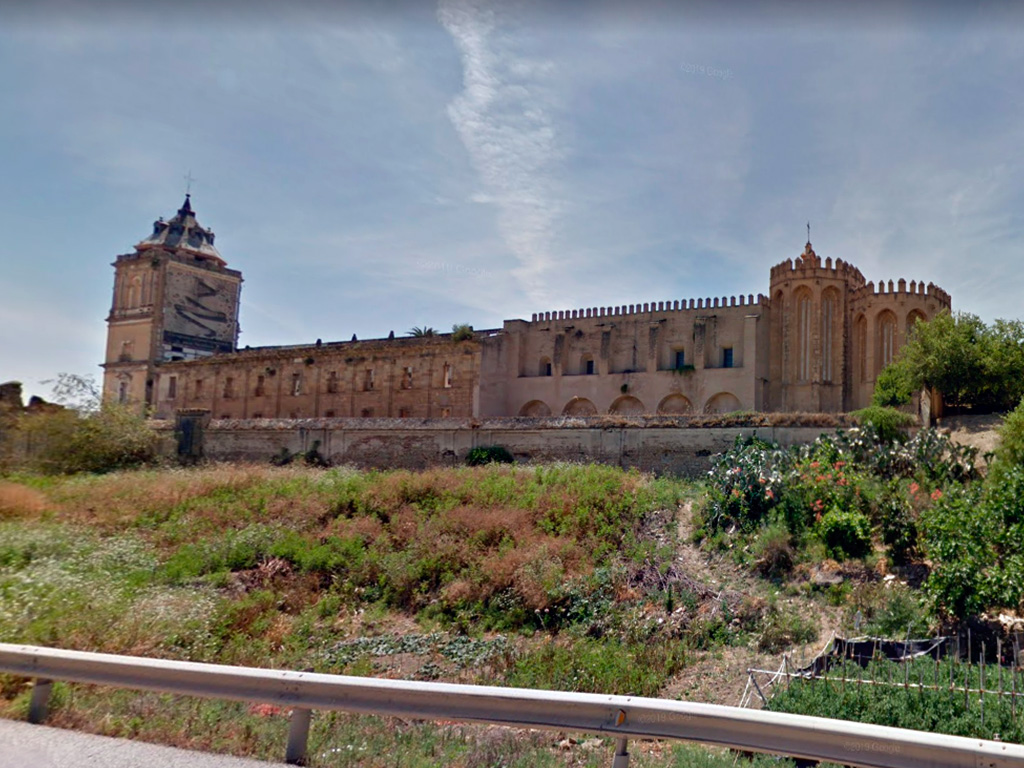
The Monastery of San Isidoro del Campo is located in the vicinity of Santiponce, 7 km. from the city of Seville.
The building was constructed in 1298 on the initiative of Alonso Pérez de Guzmán and María Alonso Coronel, with the aim of serving as a pantheon for the Guzman family. It may also have been built as an expiatory temple for the events of the siege of Tarifa, where Guzmán el Bueno threw a dagger so that his own son would be killed with it, rather than succumb to the blackmail that the besiegers made of him after capturing him.
The charter of endowment, dated in Seville in 1301, stipulates that the community chosen to occupy the convent was the Cistercian community, specifically the monks of San Pedro de Gumiel (Burgos). In 1431 the Cistercians were replaced by the Congregation of the Observance of Saint Jerome. These monks are closely linked to the history of Santiponce since, after the destruction of the town by floods, they gave some land belonging to the ancient Italica for the re-foundation of the town. In this monastery, in the mid-16th century, the translation into Spanish of one of the first published translations of the Bible, the so-called Biblia del Oso (The Bear Bible), was begun.
The monastery was confiscated in 1835, and some of its buildings were used for manufacturing purposes, such as the manufacture of tobacco, malt and beer, and it was even used as a women's prison. In 1936 it was on the verge of being demolished, but was preserved thanks to the intervention of the inhabitants of Santiponce. In 1956 the Hieronymites returned until 1978, when it was finally abandoned.
From an architectural point of view, the fortified churches stand out, in Gothic-Mudejar style, in whose cloisters and outbuildings interesting mural and canvas paintings from the 15th and 17th centuries have been preserved. The monastery buildings were organised around the cloister of the Muertos: church, sacristy, chapter house, cells, kitchen, refectory and the cloister of the Evangelists, which would have housed the porter's lodge, the church atrium and the guest quarters. Nothing has survived of the farm buildings from this time of foundation. The entire construction of the monastery corresponds to the prototype of the fortified church built after the Reconquest.
The monastery has served as a pantheon for prominent figures, such as the aforementioned Alonso Pérez de Guzmán and María Alonso Coronel and their descendants, as well as Hernán Cortés in 1547, before being transferred to Mexico. It currently belongs to the Álvarez de Toledo family.
CHAPTER ROOM
The Chapter House of the Monastery of San Isidoro del Campo was a room of special importance, as the members of the order met here to discuss important matters.
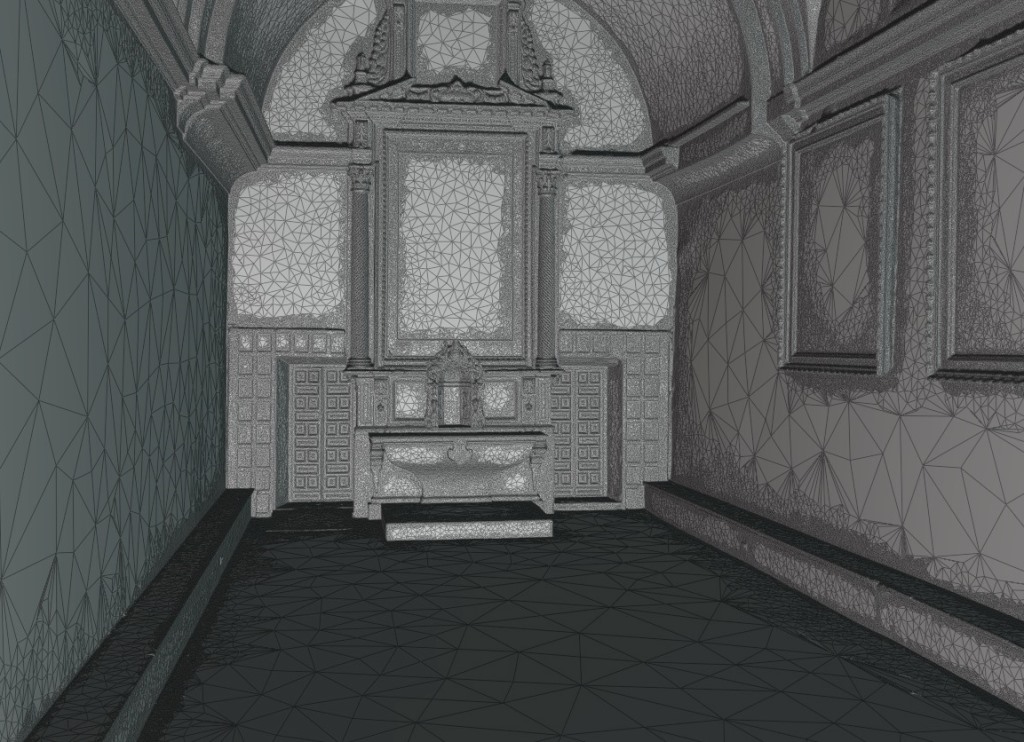
With the arrival of the Hieronymites in the second half of the 15th century, it was profoundly modified, extending in length and height by incorporating an adjoining room and eliminating the common Cistercian dormitory on the upper floor, forming a rectangular area with three bays covered with simple ribbed vaults.
During this 15th-century renovation, the mural decoration dedicated to the life of Saint Jerome was carried out, of which 5 of the 8 original scenes have been preserved. The narrative begins on the eastern wall and follows a counter-clockwise direction. Two complete scenes have been lost from this wall, the first and third, thought to be Saint Jerome scourged by the angels and Saint Jerome and Saint Paula, and only the upper part of the other two, The Imposition of the Cardinal's Capel and The Departure for the Holy Land, have survived. The western wall is better preserved, with three complete scenes: St Jerome dictating to the monks, The Apparition of the Lion and The Stealing of the Asses.
In the first third of the 17th century, a classicist decoration was installed that concealed the medieval frescoes, as they proclaimed the Hieronymites' vocation for research and study, which could be suspect after the repression of the reformist focus. In this new pictorial decoration there are allegories of Justice, Charity and Concord, virtues for good government, and angels on the vault, Saint Jerome and Saint Isidore flanking the high altar, the Prayer in the Garden and Christ of Humility on the side walls near the chancel and "Noli me tangere" and the Risen Christ on the south wall.
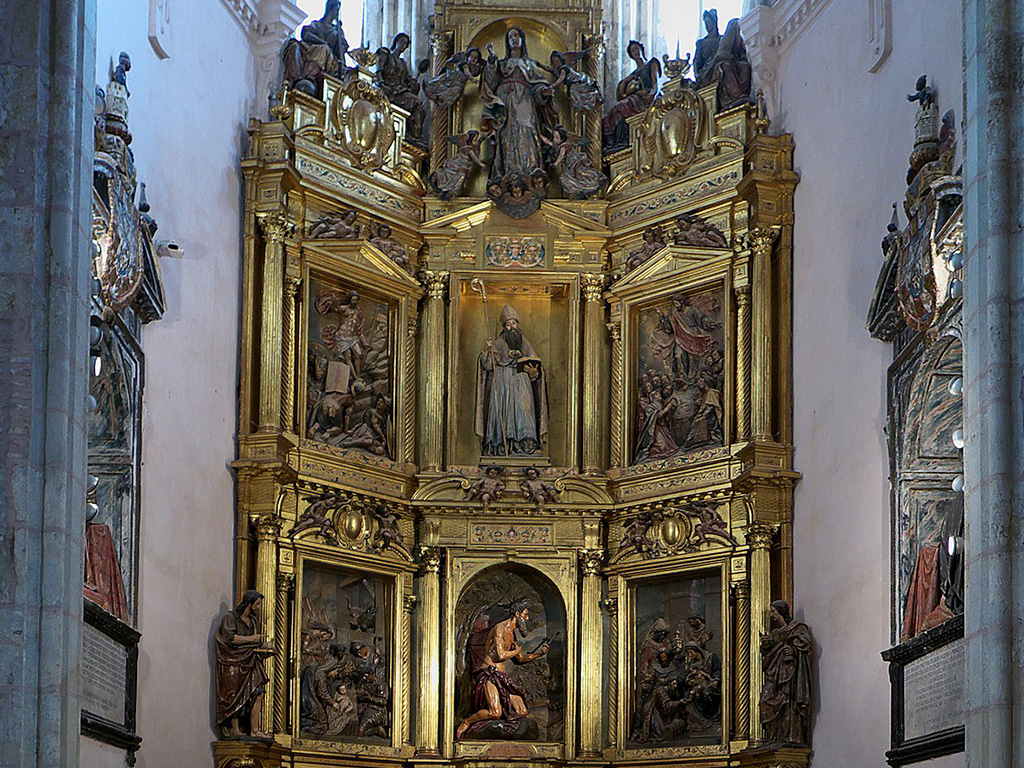
The altarpiece, also from the 17th century, is made up of a body formed by columns with Corinthian capitals that support a pediment on which the attic is located. In the centre is a canvas of Saint Peter by Pascuale Cati, an Italian artist from the second half of the 16th century, from an altar of the saint that was between the two apses of the churches. A Calvary is depicted in the attic.
A 17th century Apostolate was also hung, which copies another by Juan Navarrete el Mudo for the Monastery of San Lorenzo de El Escorial and which shows the apostles in pairs.
3D Objects
Bibliography
HERNÁNDEZ GONZÁLEZ, S. (2012). Desamortización: Monasterio de San Isidoro del Campo. En Fondos y procedencias: bibliotecas en la Biblioteca de la Universidad de Sevilla, Exposición virtual, Universidad de Sevilla.
MARTÍNEZ DE AGUIRRE, J. (1995). La primera escultura funeraria gótica en Sevilla: la Capilla Real y el Sepulcro de Guzmán el Bueno (1248-1320). Archivo Español de Arte, Tomo 68, 270, 111-130.
MATEO GÓMEZ, I., LÓPEZ YARTO, A. Y RUIZ HERNANDO, J.A. (1997). El monasterio de San Isidoro del Campo. Temas de Estética y Arte, XI, 139-180.
RESPALDIZA LAMA, P.J. (1996). El Monasterio cisterciense de San Isidoro del Campo. Laboratorio de arte, 9, 23-47.
RESPALDIZA LAMA, P.J. Y RAVÉ PRIETO, J.L. (2012) . Monasterio San Isidoro del Campo. Guía. Consejería de Cultura de la Junta de Andalucía.