
- Home
- Interest points
- Dolmen de Matarrubilla
Info
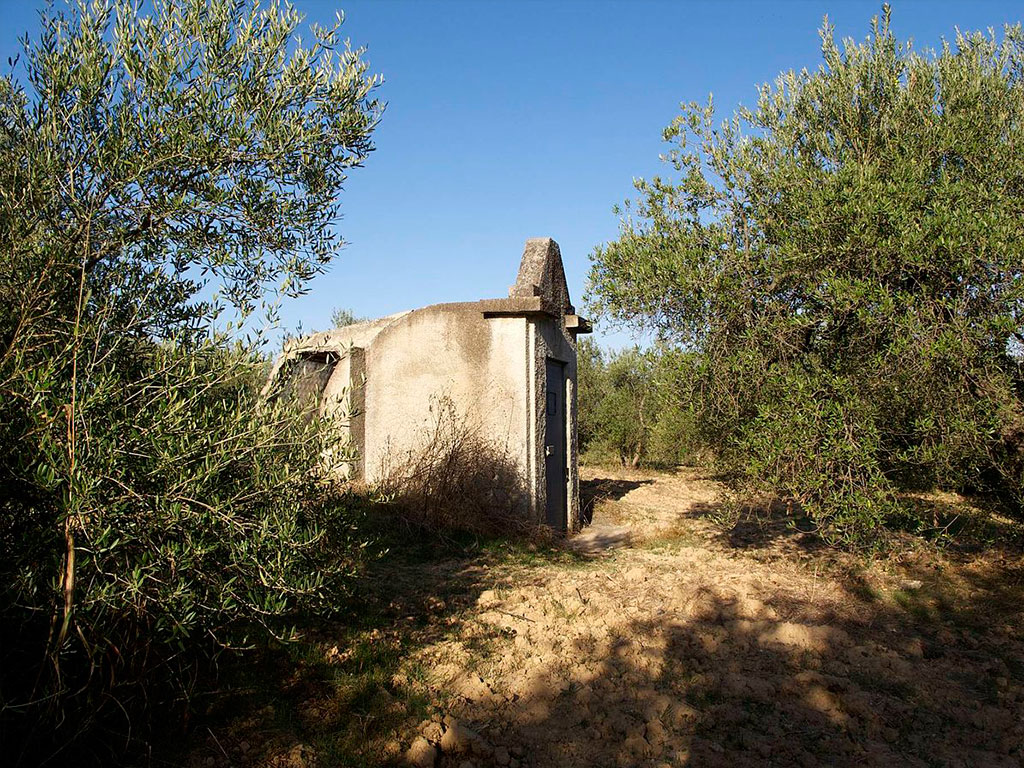
The dolmen of Matarrubilla is one of the most spectacular tombs in the area, although its burial mound has yet to be explored. It dates from the beginning of the 3rd millennium BC to the middle of the 2nd millennium BC.
Know more
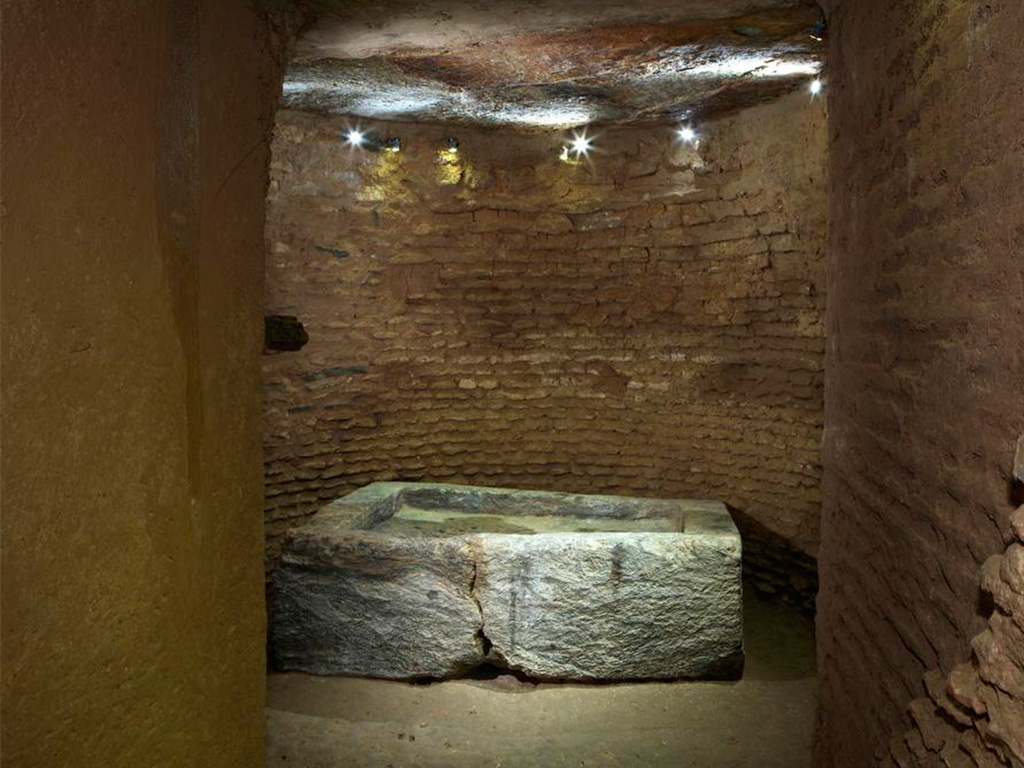
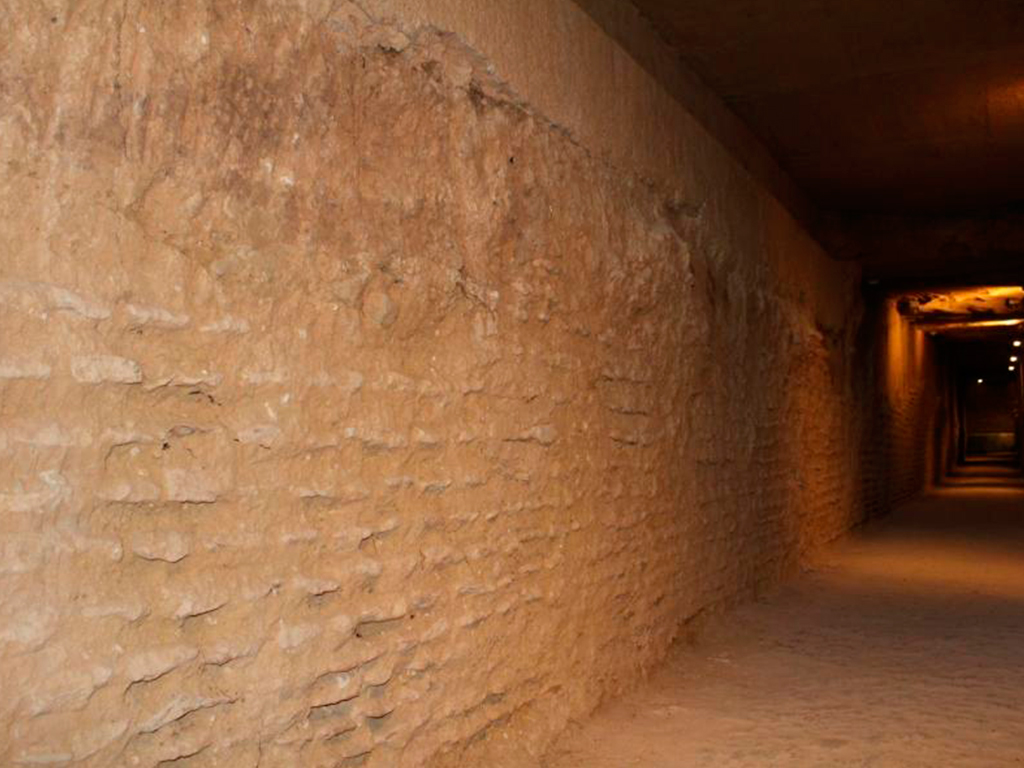
The Matarrubilla dolmen consists of a corridor 30 m. long and 2 m. high and a circular chamber 2.8 m. in diameter. All of this was covered with a tumulus 30 m. in diameter. It is one of the most spectacular tombs in the area, although the tumulus is still unexplored. Chronologically, it would extend from the first centuries of the 3rd millennium BC to the middle of the 2nd millennium BC, so it would cover practically the whole of the Copper Age and the first stage of the Bronze Age.
The floor of the corridor was made of compacted clay and the roof of limestone and sandstone, while the two slate slabs found at the beginning of the corridor were interpreted as the remains of an access door. The chamber shows masonry masonry with layers of clay kneaded into small bricks that are arranged every two courses of masonry. The false dome of the chamber was built by approximation of courses on which several sandstone stones were laid, on top of which a large granite closing slab is laid.
The burials in this funerary monument took place in the corridor, in which two individuals were buried accompanied by material from the Campaniform period (ceramic vessels, dishes, lithic material, bone, ivory, metal and gold), and each of the two individuals had an individualised trousseau with gold and ivory ornaments. These burials can be considered as reuse both because of the place where they took place, a corridor in front of the chamber, and because of the chronology, which is much later than the time of the construction of the dolmen.
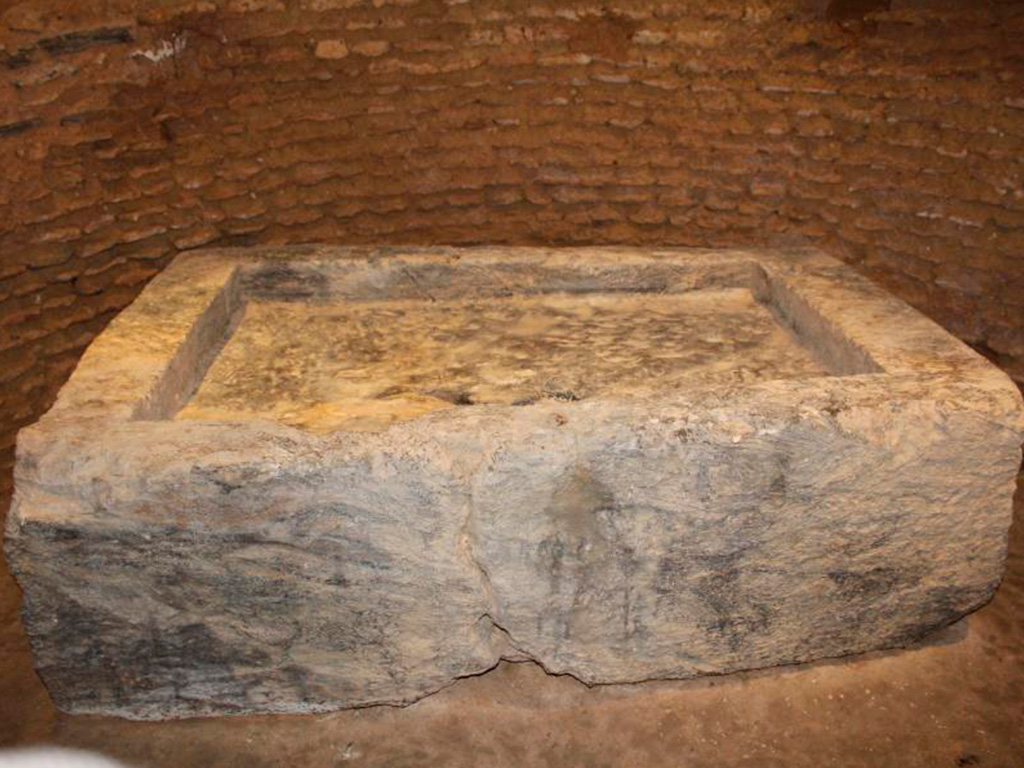
The chamber was not used as a funerary deposit, but rather as a cultic space; in this case, it was occupied by a monolithic block 1.7 m. long, 1.25 m. wide and 0.5 m. high. The Matarrubilla domen was probably conceived as a cult space in a broad sense rather than as a burial chamber in the strict sense. Ritual practices in this structure certainly included an important funerary component, but it is possible that it was designed for more than just housing human remains.
The Matarrubilla dolmen, discovered by chance in 1917 in an area of vineyards, was first excavated by Hugo Obermaier, who from the chamber (whose roof had been blown off with dynamite to access the corridor) progressed along the corridor, excavating some 10 m. of it, but then ended the intervention, concerned about the danger posed by the instability of the structure and believing that he had reached the entrance. In the 1950s, during its restoration, Francisco Collantes de Terán excavated the remaining 20 m. of the corridor. This excavation was much more fortunate in terms of artefacts found: a serpentine axe 38 cm long, three flint objects, a hemispherical bowl of marble limestone, an ovoid-shaped pebble covered with abundant remains of red pigment, a fragment of a copper awl 17 mm long, several hundred small pieces of fine gold leaf or sheet up to 4 cm in diameter, two of which were embossed, two of which are embossed, and two of which were found to have been found in the corridor, two of them embossed, a large assemblage of ceramic vessels (estimated at least 25 pieces) and several ivory objects, including a 10 cm long piece of elephant tusk, a fragment of a bracelet, three blades, a knife handle and a small walking stick. All these objects are now on display in the Seville Archaeological Museum.
3D Objects
Videos
Dolmen de Matarrubilla
Bibliography
Arribas Palau, A. (1968). Las bases económicas del Neolítico al Bronce. En Tarradell, M. (Ed.). Estudios de economía antigua de la Península Ibérica. Vicens Vives, 33-60.
Collantes de Teran, F. (1969). El dolmen de Matarrubilla. En Actas del V Symposium Internacional de Prehistoria Peninsular. Tartessos y sus problemas, 47-61.
García Sanjuán, L., Vargas Jiménez, J.M., Hurtado Pérez, V., Ruiz Moreno, T. y Cruz-Auñón Briones, R. (eds.) (2013). El Asentamiento Prehistórico de Valencina de la Concepción (Sevilla). Investigación y Tutela en el 150 aniversario del descubrimiento de La Pastora. Universidad de Sevilla.
Leisner, G., Leisner, V. (1943). Die Megalithgräber der Iberischen Halbinsel. Der Süden, Römisch-Germanische Forschungen 17.
Mata Carriazo y Arroquia, J. de (1980). Protohistoria de Sevilla. Ed. Guadalquivir.
Obermaier, H. (1919). El Dolmen de Matarrubilla (Sevilla). Junta para la Ampliación de Estudios e Investigaciones Científicas, Museo Nacional de Ciencias Naturales .