
- Home
- Interest points
- Santuario de El Carambolo
Info
Iron Age sanctuary located on the Cerro de El Carambolo.
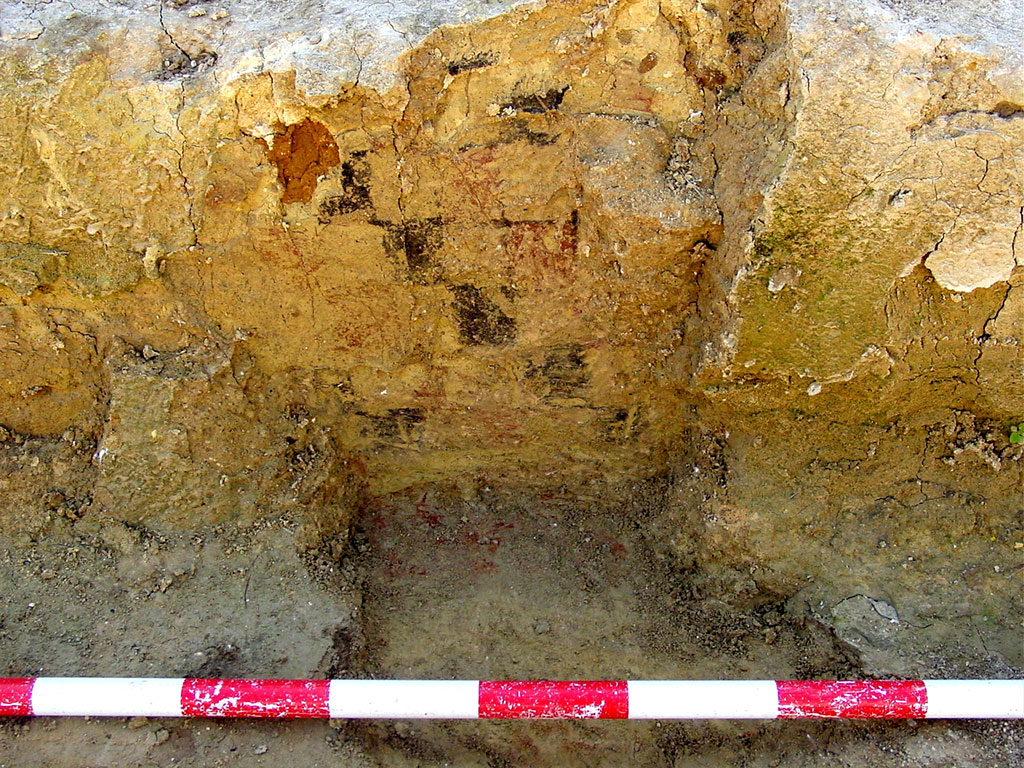
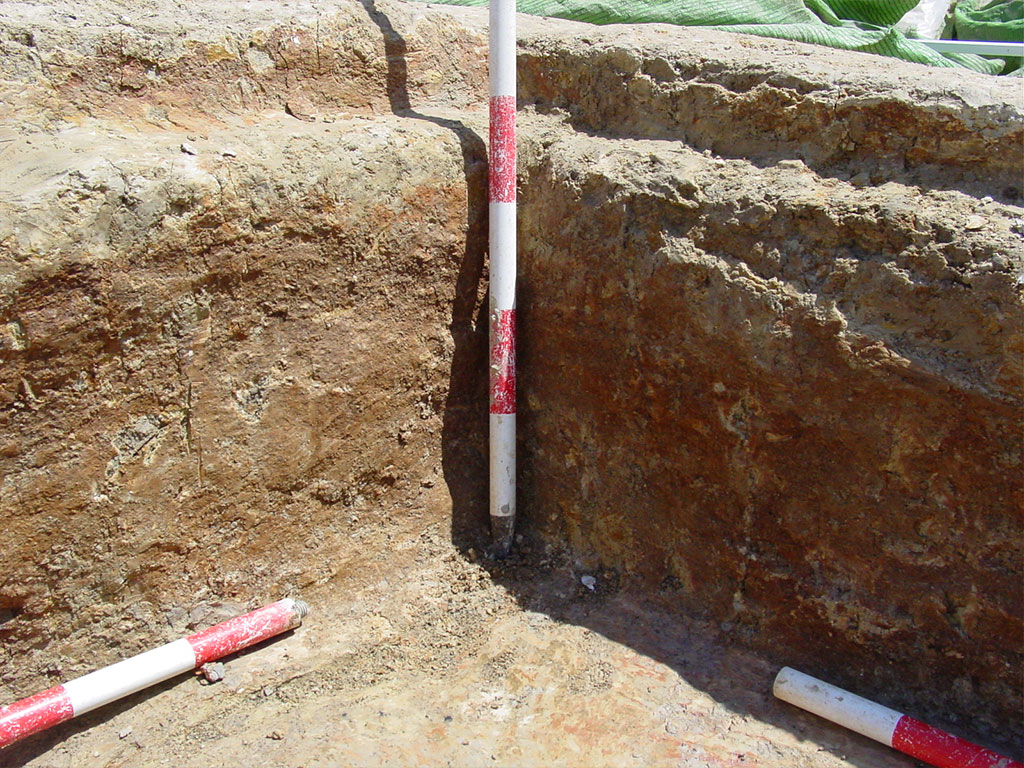
The sanctuary "El Carambolo" is not visible today. The archaeological remains were covered after the excavation was completed in order to preserve them.
Know more
On the right bank of the lower stretch of the Vega del Guadalquivir, in the municipality of Camas, we find the Cerro de El Carambolo, 84 m. high, on which lie the archaeological remains of a protohistoric sanctuary of the Orient, located opposite the ancient city of Spal (present-day Seville) from which it was separated by the tail of an arm of the sea, the Guadalquivir paleo-sanctuary.
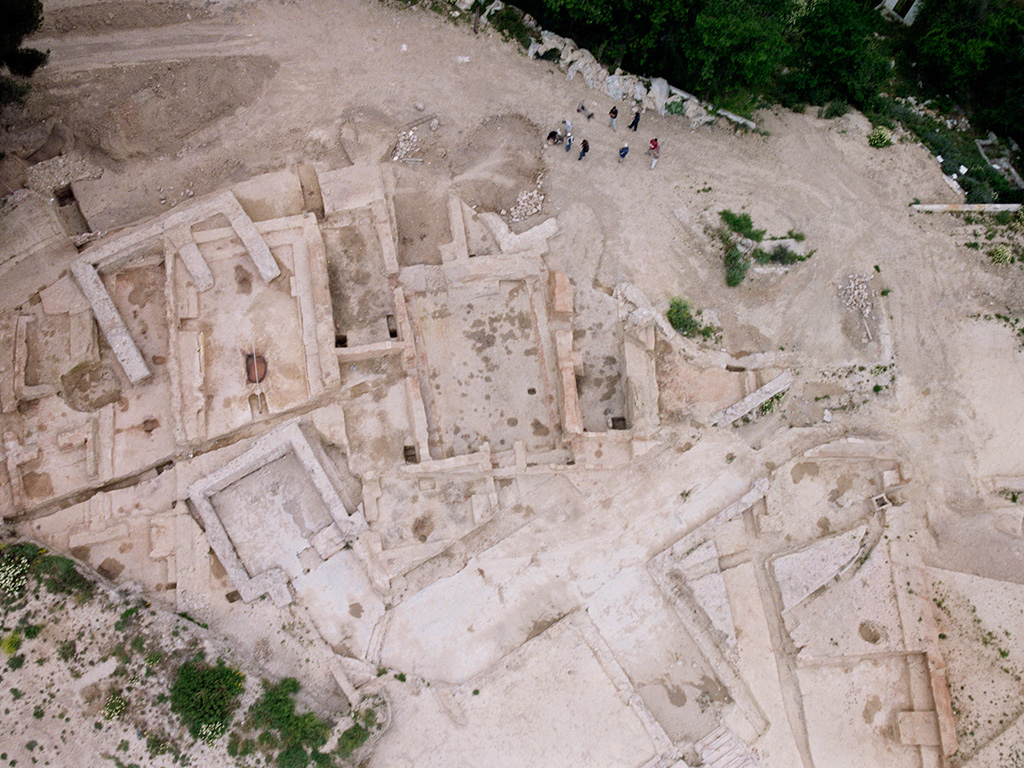
El Carambolo is one of the most important sites in research on Tartessos during the 20th and 21st centuries. Although at first the site was interpreted as a settlement of huts inhabited by indigenous people that became more complex after contact with the Phoenicians, the latest excavations carried out at the site uncovered a large building that can be interpreted as a place of worship like those existing in the Near East during the early Iron Age.
The sanctuary was founded at the end of the 9th century BC or the beginning of the 8th century BC, coinciding with the Phoenician colonisation, and was probably a dual sanctuary, dedicated to Astarte and Baal or Melkart. Due to its location, on a promontory in the Guadalquivir estuary, in addition to its sacred character, it would have served as a guide for ships sailing up the tongue of sea that went as far as Seville, as well as a place for economic and commercial transactions under the protection of the deities.
The sanctuary has been occupied for some two hundred years, during which time it was rebuilt on several occasions, always maintaining its sacred character. The initial construction, which was quite simple, became more monumentalised and complex as time went by, and was rebuilt in up to five construction phases:
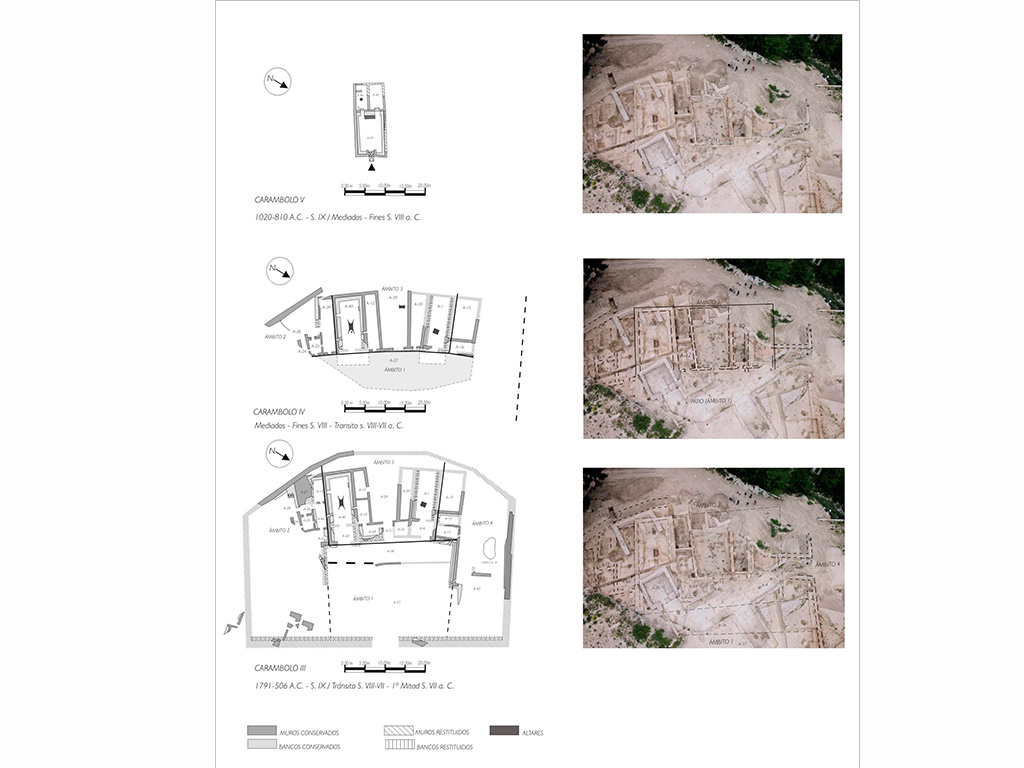
** Carambolo V, first phase of construction. Late 9th century BC to late 8th century BC. BC to the end of the 8th century BC.
The entrance leads to a large rectangular room, 12 m long and 8 m wide, with a continuous bench around the perimeter. This room would have served as a distributor and access to the other rooms of the sanctuary. This room would have been an open-air multifunctional courtyard where offerings and sacrifices were possibly prepared. The latter would take place on a stepped platform at the back of the courtyard. On either side of the platform there would be two openings that would serve as access to two rectangular rooms that are interpreted as the cult chapels.
On the left we find a room measuring 7 m. long and 3 m. wide, in the outermost part of which a series of hearths are documented and in the centre a circular altar. At the back of the room is a small room that can be interpreted as an adyton (a special area where only the priests in charge of the cult could enter).
The room on the right is structured as a rectangular room that is supposed to have the same configuration as the previous one. Next to the access step to the room, a stone was documented that can be interpreted as a betilo or sacred stone consecrated to the divinity.
** Carambolo IV, the first reform and extension of the sanctuary. Between the end of the 8th century and the transition between the 8th and 7th centuries BC.
It is divided into four areas:
Area 1: This is configured as a large open space, delimited to the southwest by the sanctuary buildings. This space acts as an antechamber to the sanctuary, articulating the accesses to the different spaces. Its paving is made of a gravel and pebble bed for drainage, on top of which there is a reddish clay-tinged earth pavement.
Area 2: The southeast area of the building is occupied by a series of quadrangular and rectangular rooms that can be interpreted as living areas. Access to these rooms is from the large courtyard, just in front of which is a rectangular room paved in red and with skirting boards in the same finish. To the right of this room is a small quadrangular room with floors finished in reddish clay.
Area 3: Located to the west, this is a series of rectangular rooms arranged around a central courtyard. Just to the left and right of this courtyard there are two rooms that may have been related to food preparation due to the presence of hearths, animal remains and ceramic remains. On either side of these rooms are two rooms that have been interpreted as worship areas due to the care taken with their finish and the presence of steps. This area can be interpreted as a religious building with two rooms for worship and, in the centre, a logistical area for the preparation of ritual offerings to the gods.
In the room on the right, we find a rectangular room measuring 5'80 x 6'60m. The remains of benches and floors are very well preserved, and in the central area a rectangular structure has been documented which has been interpreted as an altar.
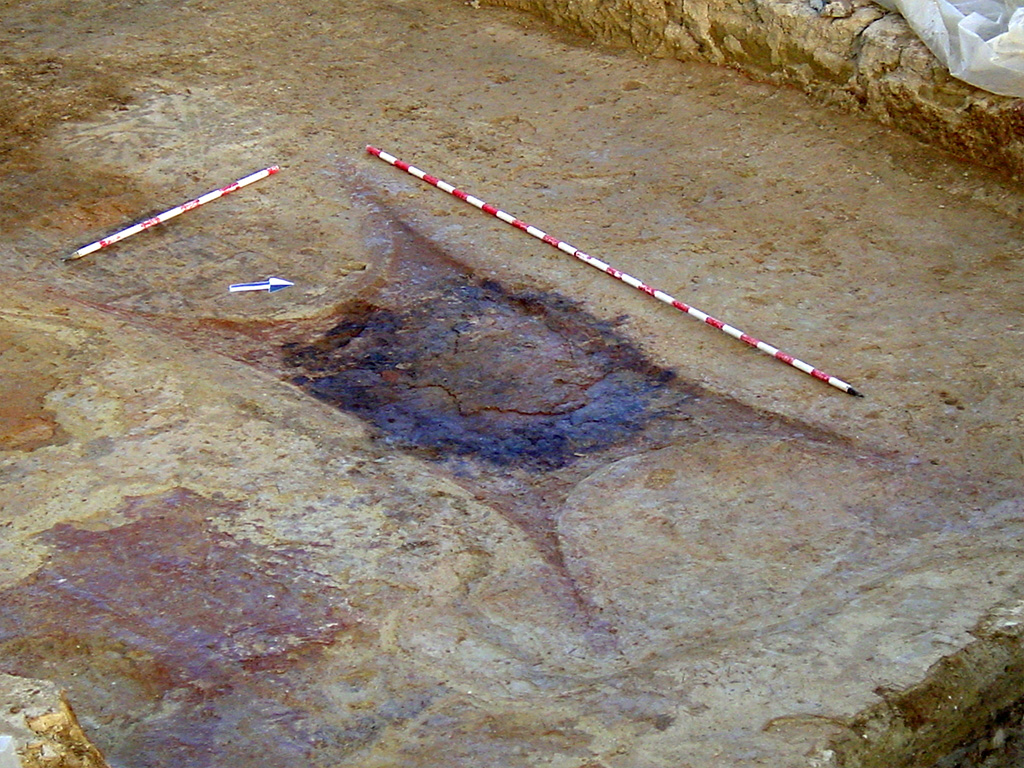
The room on the left is a room measuring 8 m x 15 m with perimeter steps decorated in red, as is the floor. In the central area an altar was found in the shape of a bull skin dyed red and with traces of burning.
Area 4: This area, located to the west of the complex, is quite affected due to the buildings that took place during the 20th century. Despite this, a couple of rectangular rooms can be made out, which seem to be an area where the sacrificial offerings from the sanctuary were dumped.
** Carambolo III, second reform and extension of the sanctuary. Between the 8th century and the first half of the 7th century BC.
The buildings are arranged around the central courtyard:
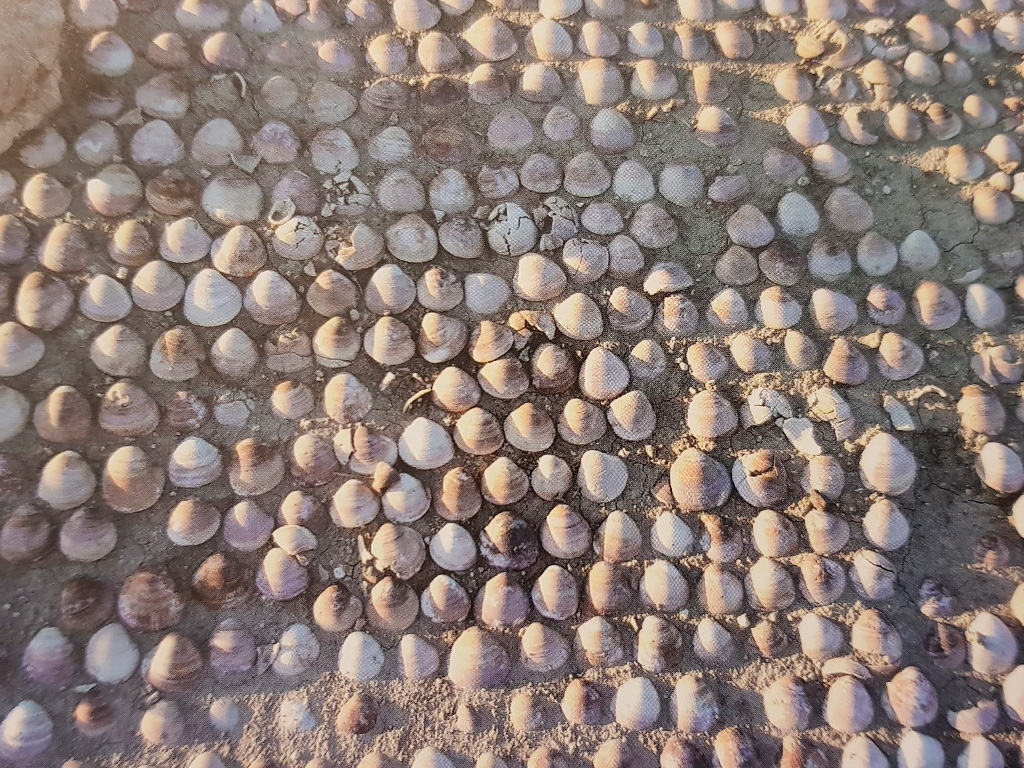
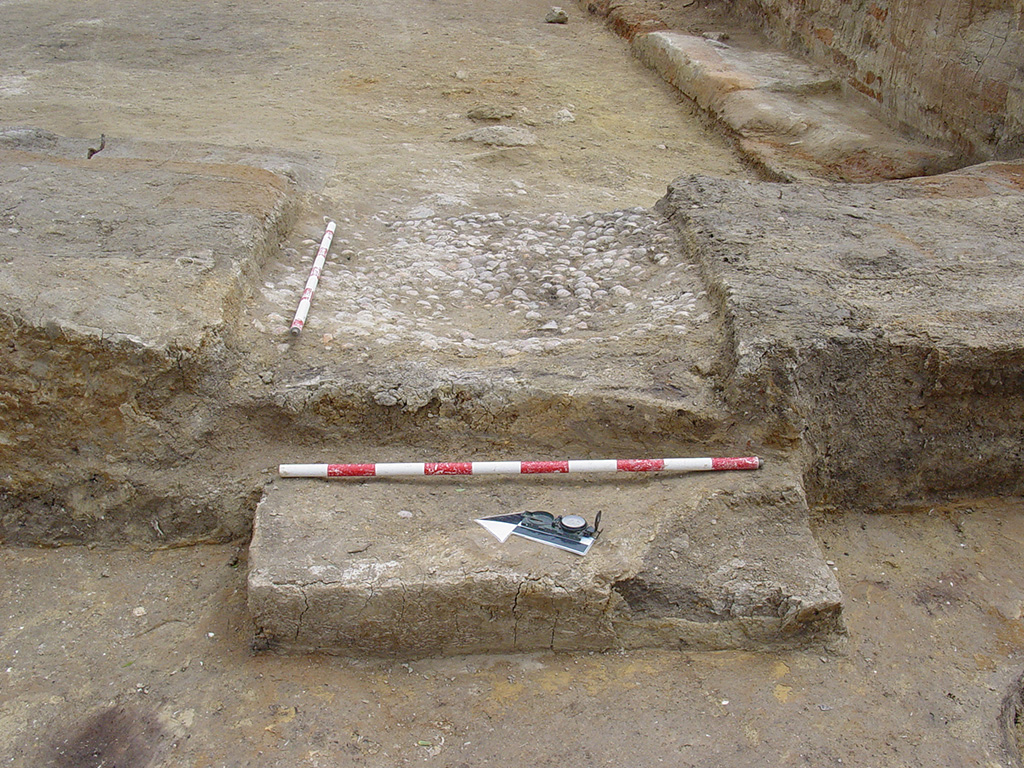
Area 1: This is a rectangular space measuring 20 x 14 m., with an east-west orientation, around which the entire sacred area is articulated. This area is paved with a beaten earth floor stained red and along the enclosing wall there is a continuous bench. Access to the building was via a rectangular porticoed transit area paved with seashells.
Area 2: During this phase, the southeast area of the building has a series of rectangular and quadrangular rooms that are connected to each other through a series of openings. Their floors are very well preserved and almost all of them have hearths located in their central area. The function of these rooms was presumably that of the sanctuary servants' quarters.
Area 3: One of the two worship rooms was renovated to create a rectangular room measuring 21 m x 9 m. The tier was decorated with a red and black chequered motif. The tier was decorated with a checkerboard motif in red and black. In the centre of the room there is an altar in the shape of a bull skin with traces of burning in its central area.
The other worship room is also quite carefully decorated. It is a room measuring 9'80 x 6'60 m. with two steps attached to the side walls decorated with red and white stripes. The floor was made of red-dyed clay and in the central area there is the same quadrangular altar as in the previous phase.
The central rooms, which are accessed through the porticoed area, continue to be used to prepare food for offerings, as shown by the presence of hearths, ovens and the remains of pottery and animals.
Area 4: This area, located to the west of the complex, is quite affected due to the buildings that took place during the 20th century. The remains that have been documented in this area are pits filled with ash deposits, organic and ceramic elements, with a similar functionality to that of the previous phase.
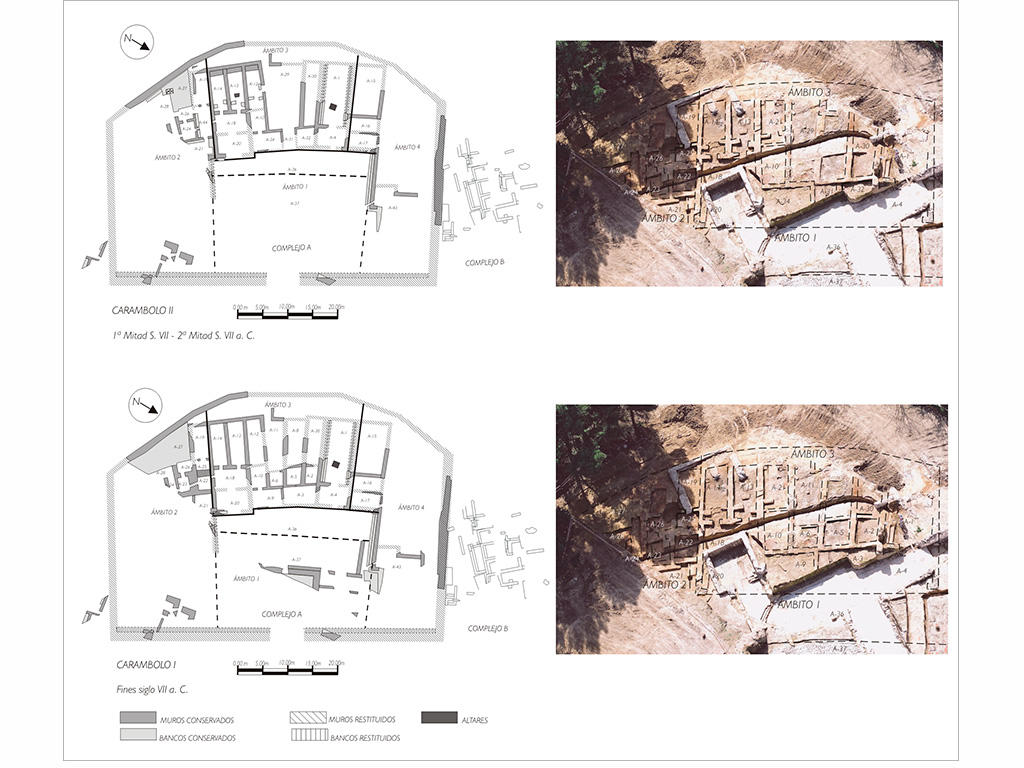
** Carambolo II, third reform of the sanctuary. Second half of the 7th century BC.
The organisation of the sanctuary remains unchanged with respect to the previous period:
Area 1: Its configuration does not change, but the rise in ground level causes a resurfacing of both the courtyard and the porticoed area with red-dyed clay slurry.
Area 2: In this area, some rooms are compartmentalized and others are resurfaced.
Area 3: At this time, the subdivision of spaces occurs. The rooms continue to be articulated around the central courtyard, with rectangular rooms on both sides. One of the two large rooms used for worship is divided longitudinally, giving rise to two new rectangular rooms by means of a wall that rests on the old altar. The function of these new rooms is unknown at the moment.
Area 4: This phase is quite poorly documented in this set. Everything suggests that the area is basically maintained as an open space of secondary character.
** Carambolo I, last documented reform of the sanctuary. The end of the 7th century B.C.
In this phase differ at least 3 of the 4 previous domains:
Area 1: in this phase there is a rise in the height of the large courtyard of the complex as a result of a series of spills of domestic origin that occur over a long period. The great ritual esplanade is compartmentalized and in front of the access there are some stands in the form of or inverse.
Area 2: This zone displays the same configuration as the previous phase. The reforms that are documented here consist of reinforcing the walls and the rise of the levels of the rooms that encompass it.
Area 3: This third area will be the most changed with the reforms of this phase. These changes focus on the compartmentalization and subdivision of some rooms and the union of others. The central courtyard will be the most affected since it will be divided into 4 rooms, two of rectangular plan and two of quadrangular plan. The result of these reforms will be the presence of a battery of six parallel rectangular rooms with northeast-southwest orientation and another battery of three rooms with southeast-northwest orientation.
3D Objects
Videos
Carambolo Sanctuary
Architectural evolution of the Sanctuary
Bibliography
DE LA BANDERA ROMERO, M. L. y FERRER ALBELDA, E. (Corrd.) (2010). El Carambolo. 50 años de un tesoro. Universidad de Sevilla.
ESCACENA CARRASCO, J.L. (2008). Arqueoastronomía en el Carambolo. Una nueva explicación para el mito del dios que muere y resucita. Andalucía en la Historia (22), 34-37.
ESCACENA CARRASCO, J.L., FERNÁNDEZ FLORES, A. y RODRÍGUEZ AZOGUE, A. (2007).Sobre el Carambolo: Un híppos sagrado del Santuario IV y su contexto arqueológico. Archivo español de arqueología, 80, 5-28.
FERNÁNDEZ FLORES, A. y RODRÍGUEZ AZOGUE, A. (2022). Tartessos Desvelado. La colonización fenicia y el origen y ocaso de Tartessos. Ed. Almuzara.
FERNÁNDEZ FLORES, A. (2005). El Carambolo. Revisión e interpretación del yacimiento a partir de los nuevos datos arqueológicos. Memoria de Licenciatura inédita. Universidad de Sevilla.
Credits
Third-party video or image resources:
Courtesy of Álvaro Fernández Flores.