
- Home
- Interest points
- Santa María de las Nieves Church
Info
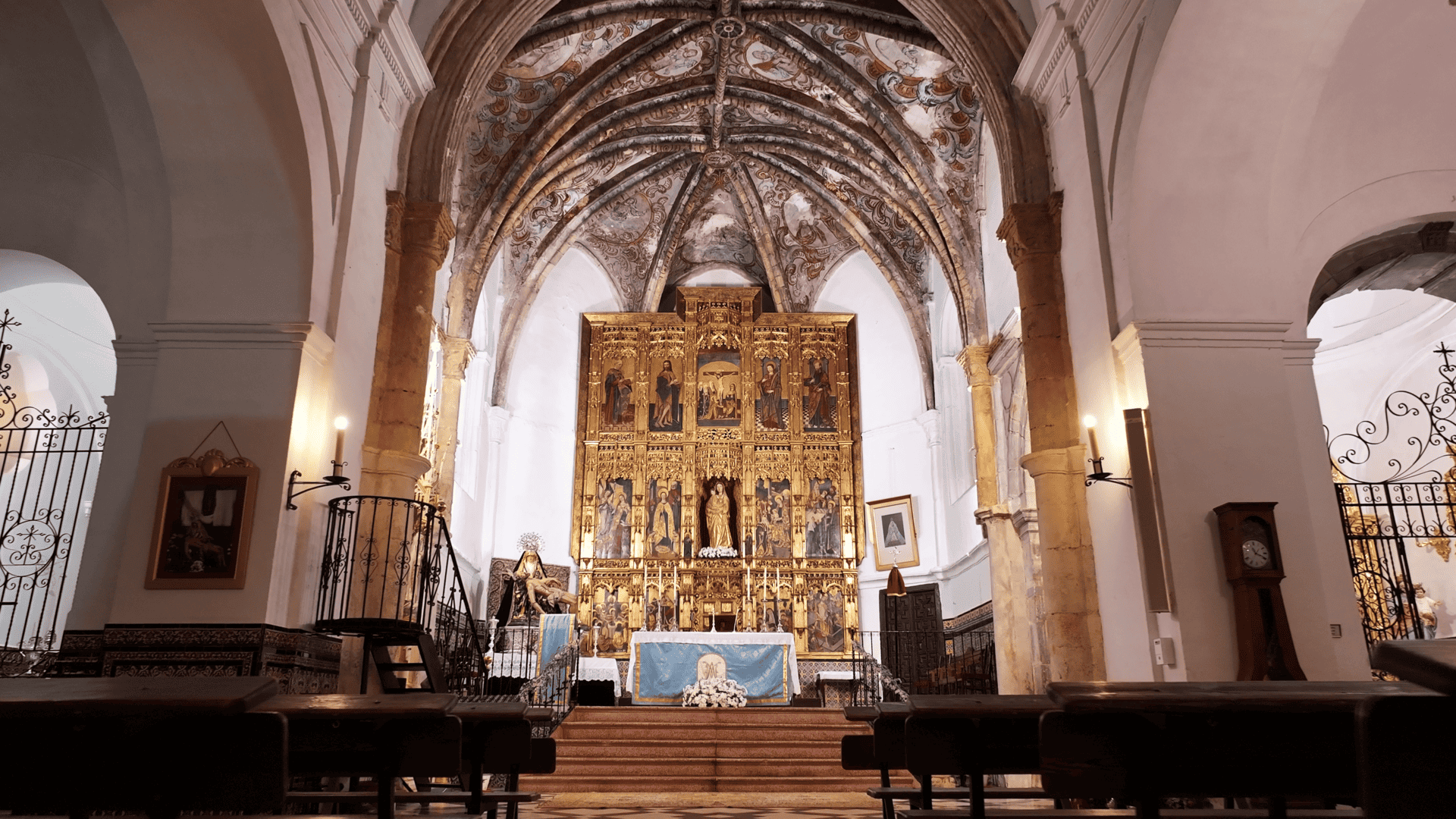
At the foot of Alanís Castle stands the church of Santa María de las Nieves, a church with over seven centuries of history that is one of the main heritage landmarks of Seville’s Sierra Morena. Its imposing tower-façade and its extraordinary high altarpiece make it a must-see.
Know more
Situated at the foot of the castle hill and overlooking the Plaza Mayor in Alanís, the parish church of Santa María de las Nieves is the town’s principal historical and artistic monument and one of the most outstanding heritage sites in the Seville region of the Sierra Morena. Its origins date back to the late 13th or early 14th century, although the present building is the result of successive alterations carried out between the 16th and 18th centuries, during which Gothic, Mudejar, Renaissance and Baroque elements were incorporated.
The church is of the Gothic-Mudejar type, with a rectangular floor plan and a polygonal chancel. It comprises three naves, each with four bays, separated by brick pillars supporting semicircular arches, which were originally pointed.
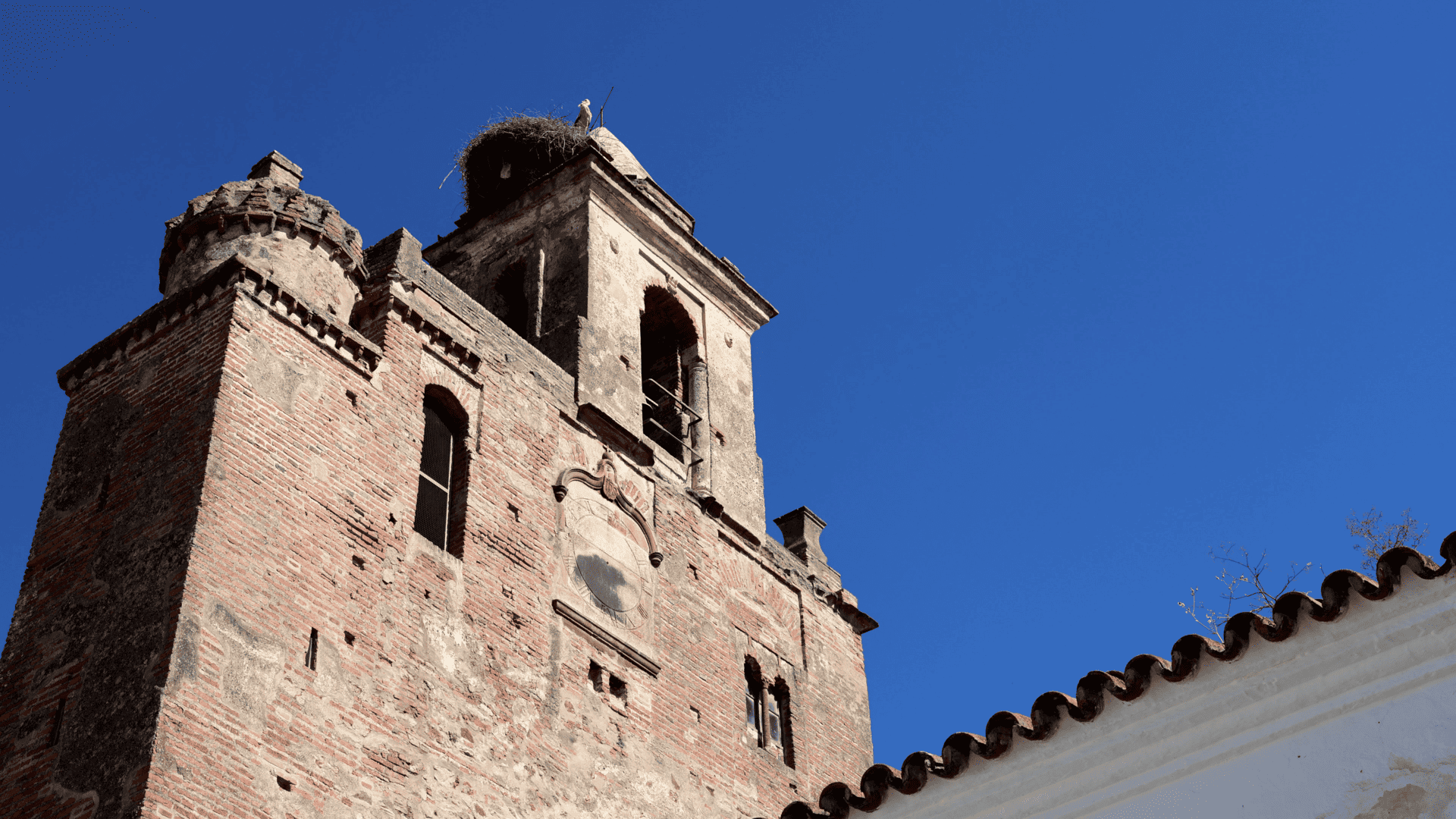
The most distinctive feature of the exterior is its imposing tower-façade, considered one of the finest examples of this style within Sevillian Mudejar architecture. Built of brick, it features traditional Mudejar mullioned windows, an ancient sundial situated beneath a ogee arch, and a bell tower topped by an 18th-century tiled spire; it is one of the most recognisable features of Alanís’s townscape.
Access to the church is via two stone doorways, situated on the Gospel and Epistle sides. Both are characterised by great decorative restraint, although they retain elements typical of the late Gothic style, such as arches framed by an alfiz and diamond-point decoration. The entrance on the Epistle side preserves three modillions in the Cordoban tradition, which belonged to the former canopy that sheltered the entrance.
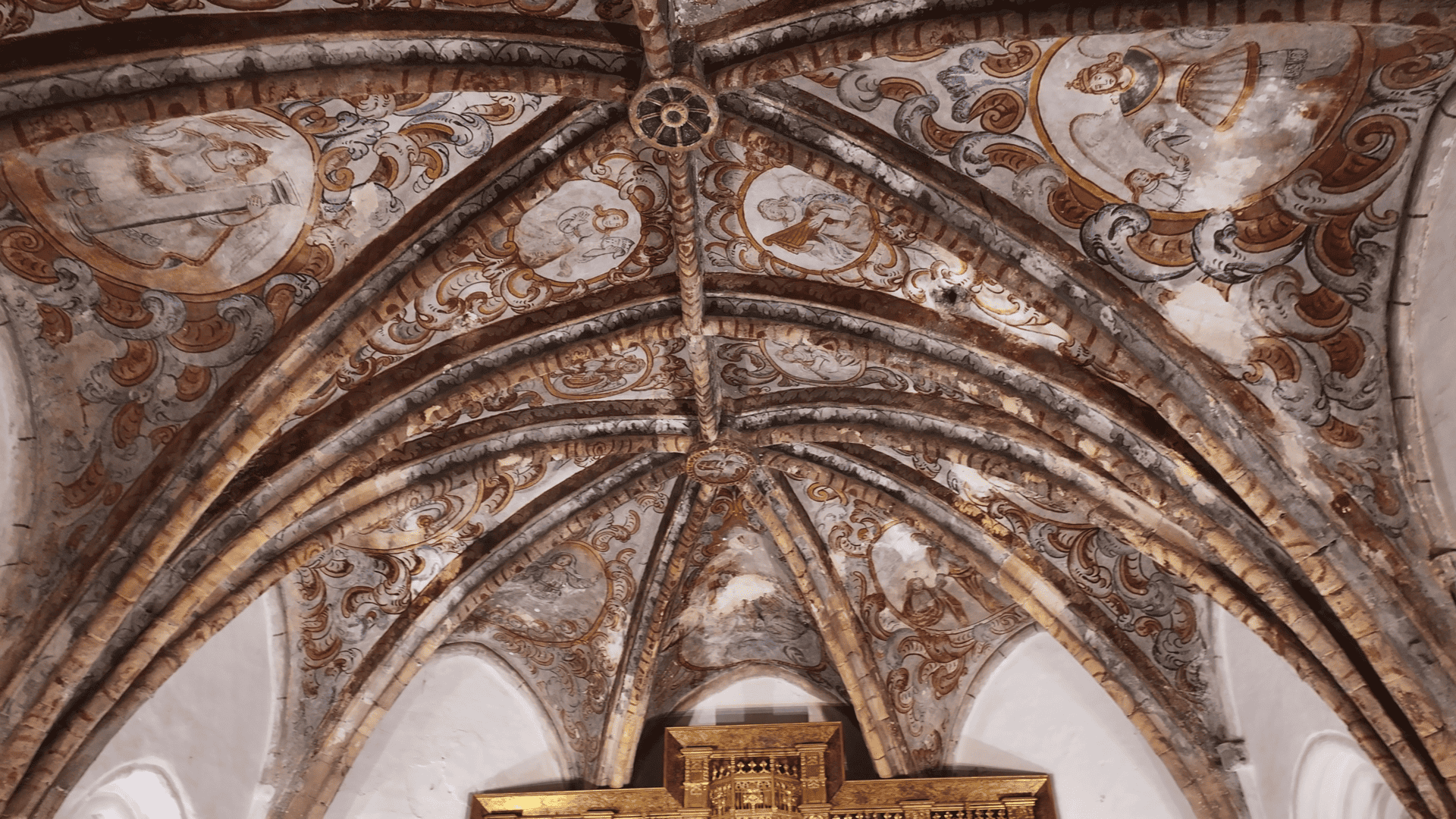
The interior is striking for the spaciousness of its three naves and the simplicity of its whitewashed walls, which contrast with the artistic richness of the chancel, the oldest part of the building. The chancel retains an elegant ribbed vault, the ribs of which rest on columns set into the wall, with capitals decorated with human figures and plant motifs. During the 18th century, this space was embellished with Baroque murals that lend a remarkable sense of dynamism to the whole.
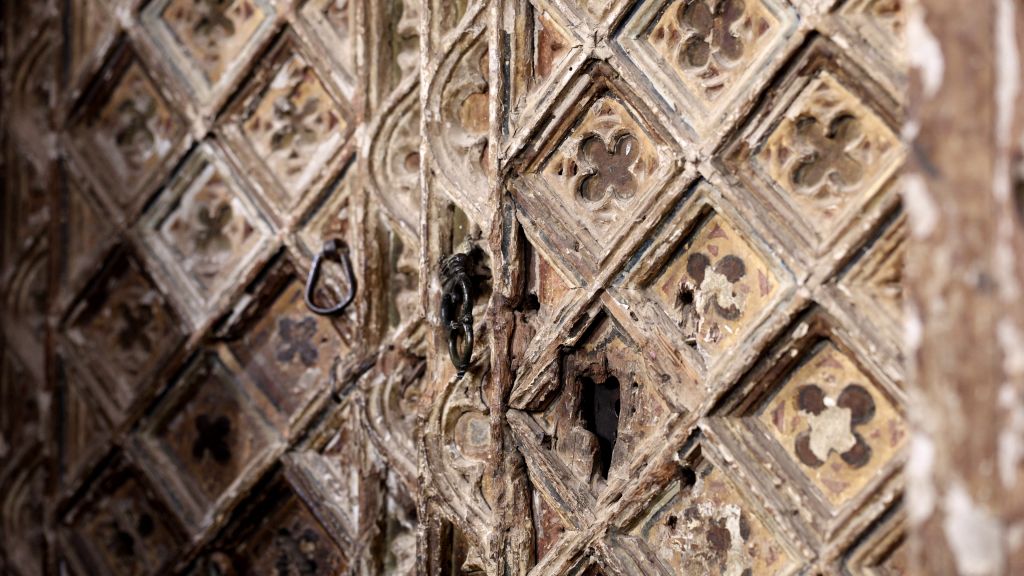
Among the adjoining rooms, the Chapel of the Purification of Our Lady, built in the late 16th century, stands out, as does the former chapel used for the reservation of the Eucharist, which is connected to the chancel by a magnificent carved wooden Mudejar door – one of the most valuable examples of historic woodwork preserved in the church. Next to the choir there is also an interesting 15th-century Mudejar baptismal font carved from stone.
The High Altarpiece
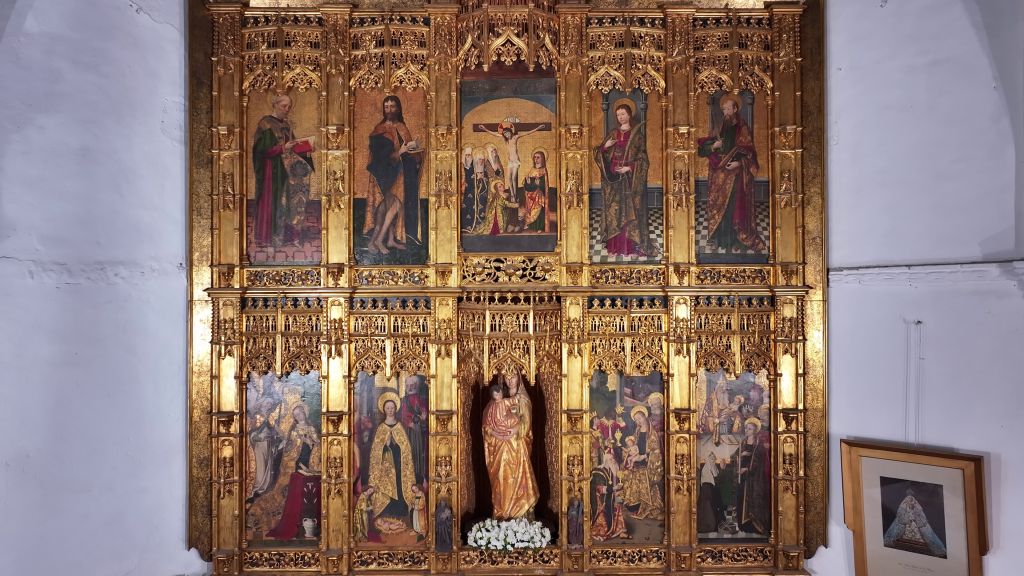
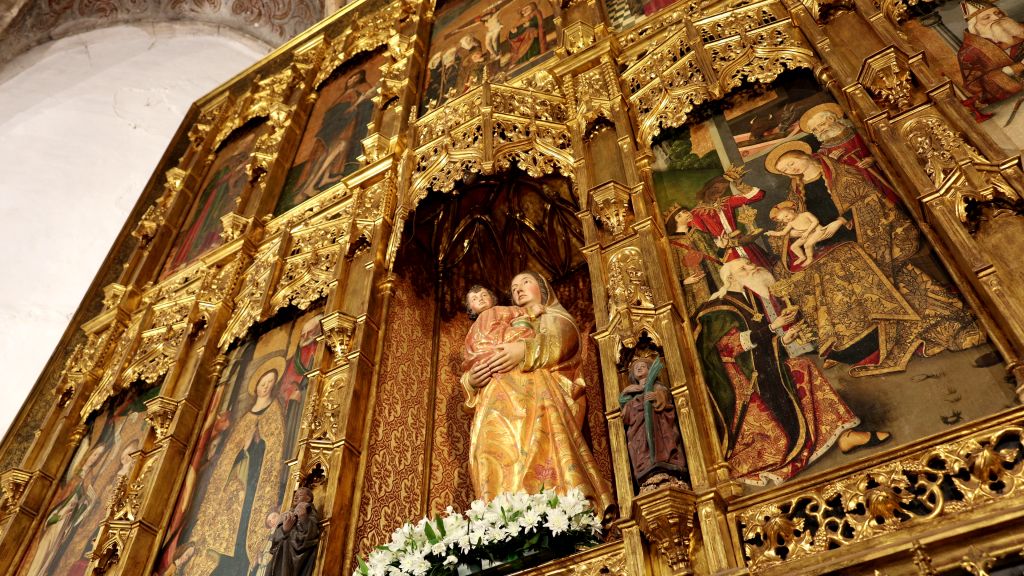
The parish’s greatest artistic treasure is, without doubt, its High Altarpiece, regarded as one of the masterpieces of early 16th-century Sevillian Hispano-Flemish painting and one of the most valuable collections of paintings preserved in western Andalusia.
It was installed in 1508, according to documents preserved in the parish archives. Its authorship remains a subject of debate amongst specialists. Although it has traditionally been linked to painters such as Juan Sánchez de Castro, Francisco López de Villalobos and Francisco de Villegas, the most widely accepted theory holds that it was created by several artists belonging to the Sevillian school around 1500.
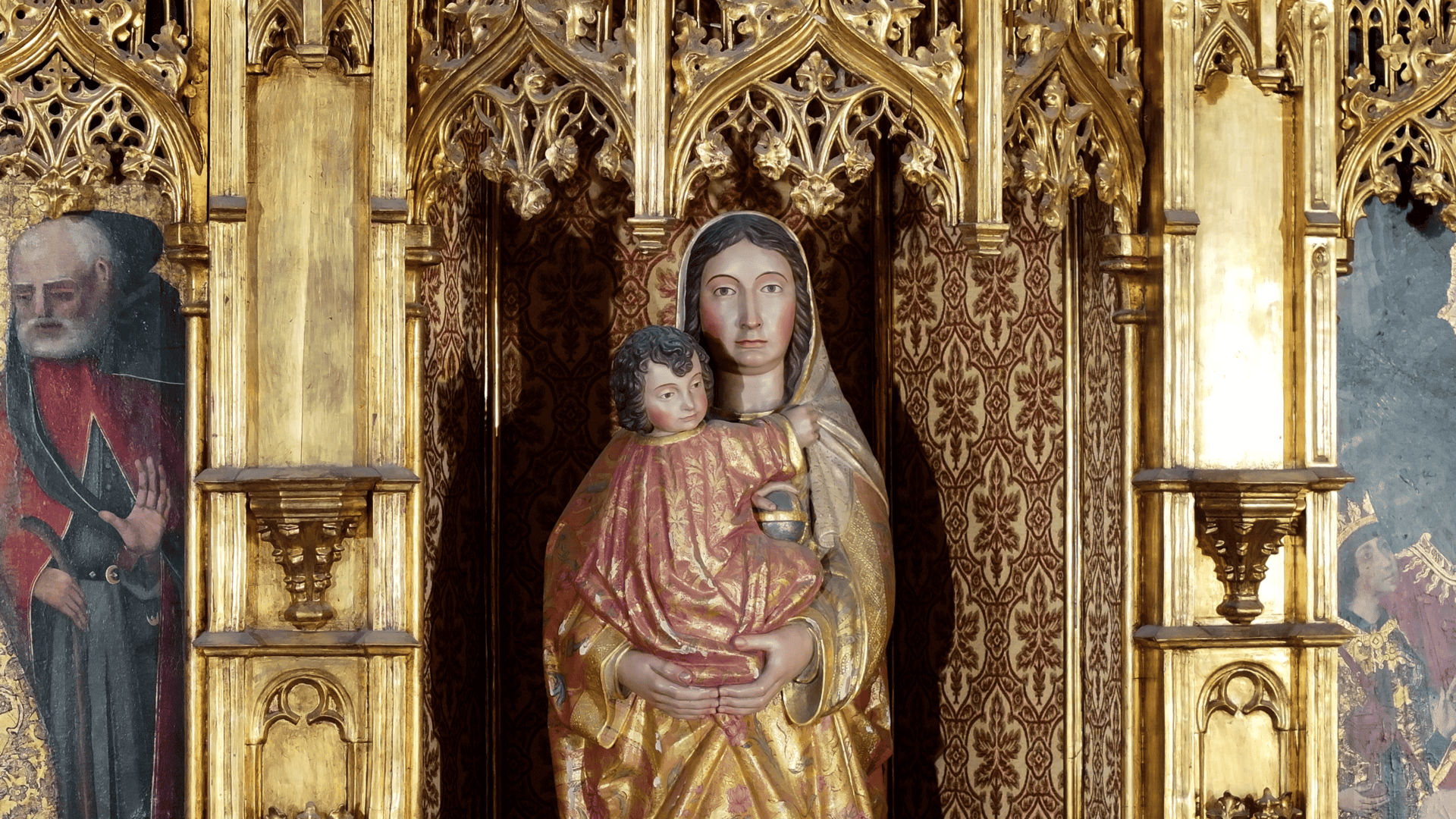
The altarpiece suffered significant damage during the events of 1936, when a fire destroyed the original image of Our Lady of the Snows, the parish’s patron saint, as well as a large part of the central aisle of the ensemble. Between 1966 and 1971, it underwent extensive restoration by the Spanish Institute of Cultural Heritage, which enabled much of its original appearance to be restored. The image that currently presides over the altarpiece is a modern reproduction inspired by the original carving, which has been lost.
The ensemble follows the style known as a ‘retablo de batea’ and is organised into a lower bench, a main section and an attic, arranged across five sections housing a total of thirteen painted panels. Its structure is enhanced by extraordinary architectural decoration consisting of delicate canopies, in which late Gothic motifs coexist with Mudejar decorative elements. Numerous pedestals were arranged between the sections, upon which some thirty small polychrome wooden sculptures originally stood; of these, only two remain today, situated on either side of the central image.
The altarpiece presents a comprehensive iconographic programme dedicated to the life of Christ and the Virgin Mary, culminating in the depiction of Calvary and various patron saints. The paintings show a clear influence from the engravings of the German master Martin Schöngauer and are notable for the elegance of their figures, the careful psychological study of the characters, the rich colour palette and the meticulous detail with which the fabrics, the folds of the garments and the small decorative details are rendered.
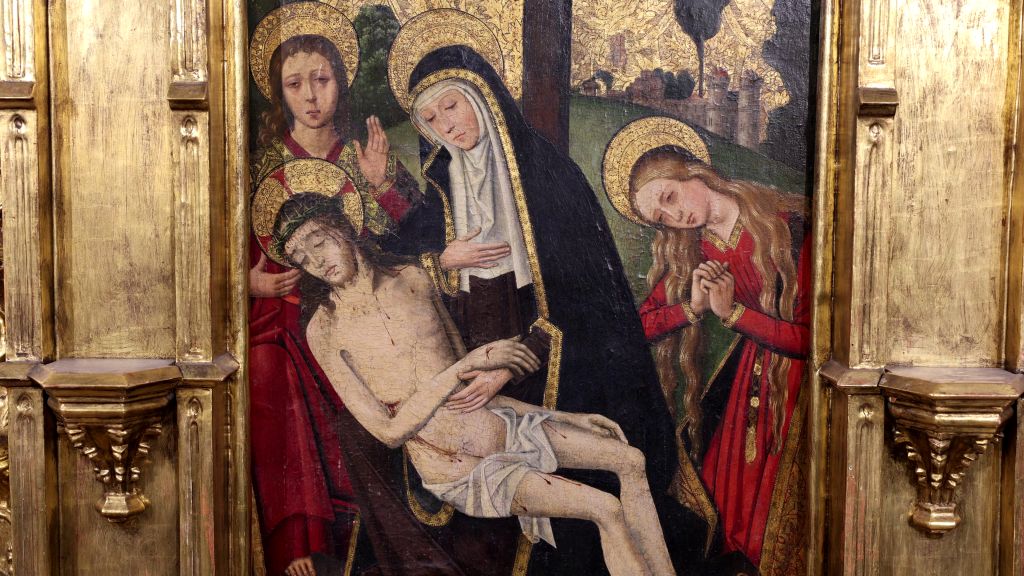
• The altarpiece: The Passion of Christ: The altarpiece comprises four scenes depicting the Passion of Christ. At the Last Supper, Christ foretells Judas’s betrayal as both men simultaneously dip their hands into the same dish. Saint John is shown reclining on Christ’s chest, and the entire composition stands out for its extraordinary psychological portrayal of the apostles. The Crowning with Thorns presents the contrast between Christ’s serenity and the violent movements of the executioners who humiliate him, establishing a powerful symbolic opposition between good and evil. The Fifth Sorrow depicts the Virgin Mary holding the body of Christ, freshly taken down from the cross, in a scene of intense drama and profound humanity. The cycle concludes with the Resurrection, in which Christ appears victorious above the tomb, blessing the viewer, whilst a single soldier remains awake. Both this panel and the Fifth Sorrow feature an interesting treatment of the landscape, which is unusual in the rest of the series.
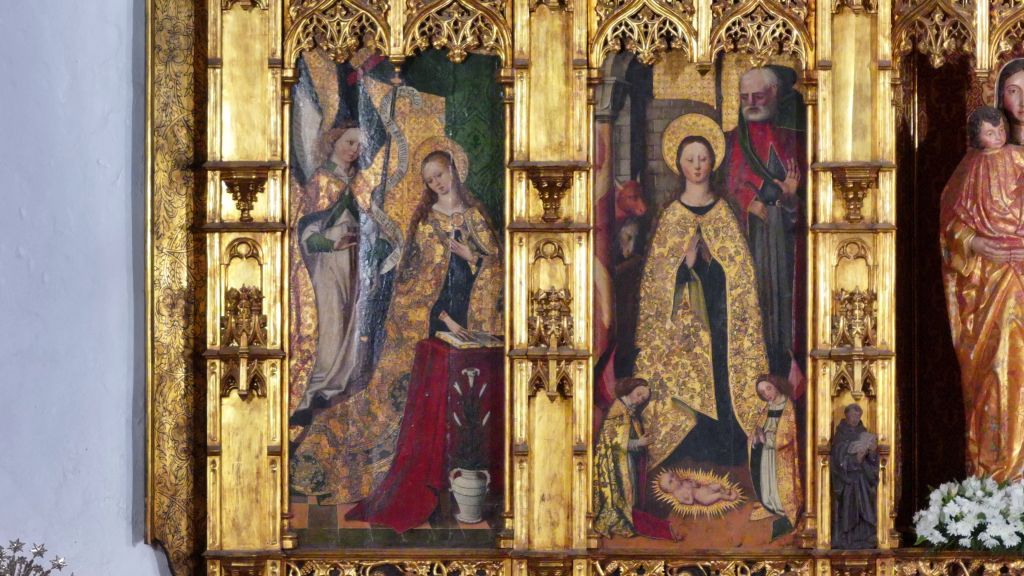
• The first section: the life of the Virgin: The four panels of the main section are devoted to some of the most important episodes in the life of Mary. The Annunciation, regarded alongside the Nativity as one of the altarpiece’s finest works, depicts the Virgin serenely receiving the announcement from the Archangel Gabriel. The lilies in the foreground symbolise her purity. In the Nativity, Mary occupies the centre of the composition, draped in rich fabrics that demonstrate the painters’ extraordinary technical skill, whilst the other figures are subordinate to the figure of the Mother of Christ. The Epiphany depicts the adoration of the Magi before the Infant Jesus and is notable for the presence of a figure traditionally identified as Ferdinand the Catholic, represented as King Caspar. The Circumcision combines two iconographic episodes: the circumcision of the Child, symbolised by the knife placed on the table, and the Presentation of Christ in the Temple, evoked by the doves in the offering and the candle held by the Virgin as a symbol of her purification.
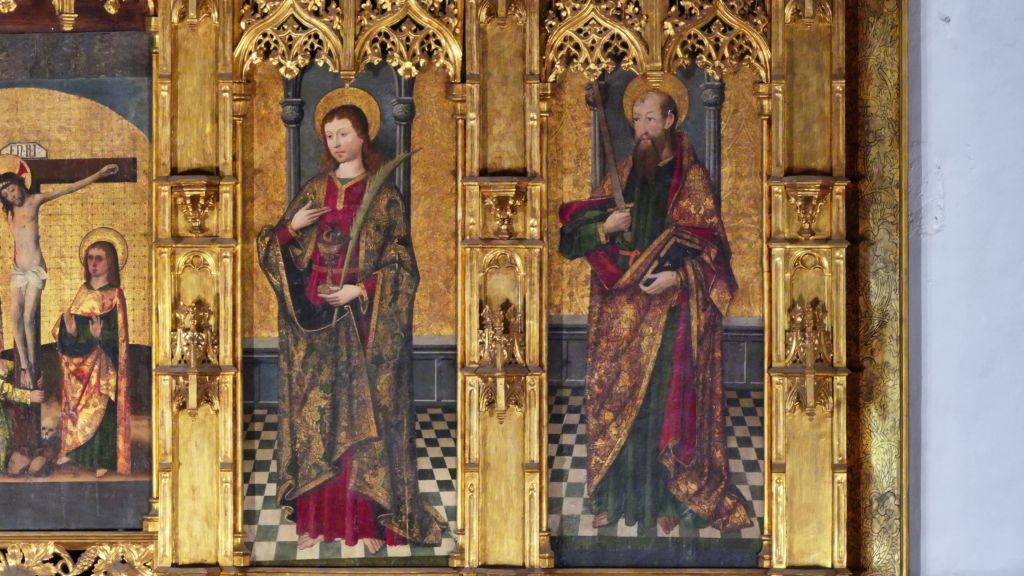
• The attic: Calvary and the patron saints: The iconographic programme culminates with Calvary, presided over by Christ on the cross and accompanied by Saint John the Evangelist, Mary Magdalene and the Three Marys. Flanking this scene are Saint Peter, Saint John the Baptist, Saint John the Evangelist and Saint Paul, figures who complete the doctrinal and devotional significance of the altarpiece.
Videos
Santa María de las Nieves Church
Santa María de las Nieves Church Subtitled
Bibliography
- ANGULO ÍÑIGUEZ, Diego (1932; reed. 1983): Arquitectura mudéjar sevillana de los siglos XIII, XIV y XV. Ayuntamiento de Sevilla.
• HERNÁNDEZ DÍAZ, José; SANCHO CORBACHO, Antonio y COLLANTES DE TERÁN, Francisco (1939): Catálogo arqueológico y artístico de la provincia de Sevilla. Tomo I. Sevilla: Imprenta de la Gavidia.
• MORALES, Alfredo J.; SANZ, María Jesús; SERRA, Juan Miguel y VALDIVIESO, Enrique (1981): Guía artística de Sevilla y su provincia. Sevilla: Diputación Provincial de Sevilla.
• PÉREZ, Antonio (2019): Iglesia Parroquial de Alanís (S. XIV). Trabajo de investigación inédito.
http://www.alanis-aperez.es/mizona/IGLESIA%20PARROQUIAL.pdf
• PÉREZ, Antonio (2019): Retablo Mayor (1508). Iglesia Parroquial de Alanís. Trabajo de investigación inédito.
http://www.alanis-aperez.es/mizona/RETABLO%20%20MAYOR.pdf
Fuentes on line:
Guía digital del patrimonio cultural de Andalucía. Instituto Andaluz de Patrimonio Histórico. Consejería de Cultura y Deporte:
Instituto de Patrimonio Cultural de España: